Can I Drive My Tacoma Without a Catalytic Converter
You technically can drive a Toyota Tacoma without a catalytic converter, but it comes with serious risks. Removing this key part of your exhaust system can trigger engine light warnings, fail emissions tests, and even damage your engine over time. Before you decide to remove or replace a stolen converter, you need to understand the legal, mechanical, and environmental implications involved.
So you are wondering whether you can keep driving your Toyota Tacoma after losing or removing the catalytic converter. Maybe it got stolen. Maybe someone told you to just take it off for better performance. Or maybe you are dealing with a clogged converter and want a quick fix. Whatever the reason, this is a question a lot of Tacoma owners ask.
The short answer is yes. Your truck will physically run without a catalytic converter. But the real question is whether you should. Driving without this important exhaust component can cause a long list of problems. These range from annoying dashboard warnings to serious engine damage over time. It also carries legal risks that can result in heavy fines.
In this article, we will walk through everything you need to know. We will cover what the catalytic converter does, what happens when it is missing, the legal side of things, and what your options are. By the end, you will have a clear picture of whether this is a quick hack or a costly mistake.
Key Takeaways
- Yes, you can drive: Your Tacoma will run without a catalytic converter, but it is not recommended for long-term use.
- Check engine light will appear: The OBD2 system will detect missing sensors and throw error codes immediately.
- Legal consequences exist: Federal and state laws prohibit removing catalytic converters on public roads.
- Engine damage is possible: Running without the converter can affect fuel mixture, oxygen sensors, and exhaust flow.
- Costly repairs ahead: Ignoring the issue can lead to expensive exhaust system repairs down the road.
- Alternatives exist: High-flow catalytic converters and aftermarket exhaust options can improve performance legally.
📑 Table of Contents
- What Does a Catalytic Converter Do?
- Can You Actually Drive Without One?
- Is It Legal to Remove a Catalytic Converter?
- What Are the Risks of Driving Without a Converter?
- What Should You Do If Your Converter Is Missing or Damaged?
- How to Tell If Your Catalytic Converter Is Failing
- Common Mistakes People Make With Catalytic Converters
- Expert Insights on Tacoma Exhaust Systems
- Key Takeaways
- Conclusion
What Does a Catalytic Converter Do?
Before we dive into whether you can drive without one, let us talk about what this part actually does. Many Tacoma owners overlook the catalytic converter, but it plays a huge role in your truck’s exhaust system. Without understanding its purpose, it is hard to know why removing it causes problems.
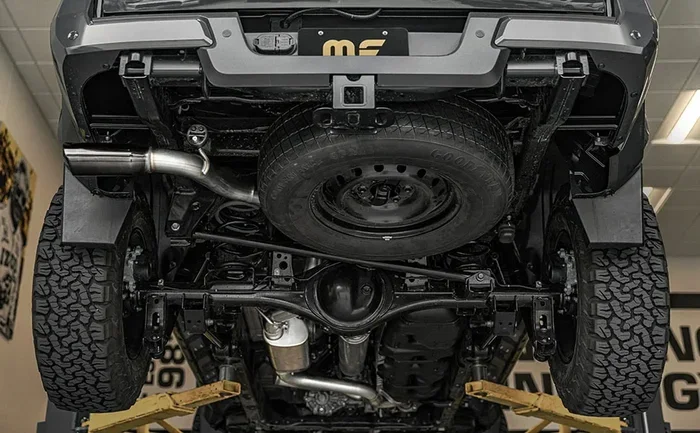
The catalytic converter sits between your exhaust manifold and the muffler. Its job is to clean up harmful exhaust gases before they exit the tailpipe. It converts toxic pollutants like carbon monoxide, nitrogen oxides, and hydrocarbons into less harmful substances. Think of it as a filter for your truck’s exhaust fumes.
How It Works in Your Tacoma
Inside the catalytic converter, there are precious metals like platinum, palladium, and rhodium. These metals act as catalysts. They trigger chemical reactions that break down dangerous emissions. When hot exhaust gases flow through the converter, these reactions happen automatically. The result is cleaner air coming out of your tailpipe.
Your Tacoma’s oxygen sensors work closely with the catalytic converter. These sensors measure how much oxygen is in the exhaust. They send data to the engine control unit, also known as the ECU. The ECU then adjusts the fuel mixture to keep your engine running efficiently. Without a working converter, this entire system gets thrown off balance.
Can You Actually Drive Without One?
Let us get straight to the point. Can you drive your Tacoma without a catalytic converter? Technically, yes. The engine does not need the converter to combust fuel. Your truck will start, idle, and accelerate without it. Many people who have had their converter stolen report driving their Tacoma to the shop without immediate issues.
But just because you can does not mean you should. Removing the catalytic converter changes how your exhaust system operates. It affects backpressure, fuel trim, and sensor readings. These changes might seem small at first, but they add up fast. Over time, you could face serious mechanical problems.
What Happens Right After Removal
The moment you drive without a catalytic converter, your truck’s computer notices. The OBD2 system will detect that the oxygen sensors are not reading normal values. Within seconds, the check engine light will turn on. You might also notice a loud, rattling exhaust sound that is very different from normal.
Here are the most common immediate effects:
- Check engine light activates within seconds of starting the engine.
- Rough idle or uneven engine performance at low speeds.
- Increased exhaust noise that is significantly louder than normal.
- Sulfur or rotten egg smell coming from the exhaust pipe.
- Reduced fuel economy as the ECU struggles to compensate.
Long-Term Driving Without a Converter
If you keep driving your Tacoma without a catalytic converter, the problems get worse. The ECU relies on the upstream and downstream oxygen sensors to maintain the correct air-fuel ratio. When those sensors read abnormal values constantly, the ECU enters a default mode. It starts running the engine rich, meaning it dumps too much fuel into the combustion chambers.
Running rich for extended periods causes several issues. Your fuel consumption goes up. Unburned fuel passes into the exhaust system and can damage the oxygen sensors further. It can also contaminate the muffler and exhaust pipes. In worst-case scenarios, the excess fuel can cause catalytic converter overheating in other parts of the exhaust system, even if those parts are still intact.
Is It Legal to Remove a Catalytic Converter?
This is where things get serious. In the United States, removing a catalytic converter from a vehicle used on public roads is illegal under federal law. The Clean Air Act regulates emissions from all vehicles sold for road use. Tampering with or removing emissions control equipment, including the catalytic converter, is a violation of this law.
Federal Laws and Penalties
The Environmental Protection Agency, or EPA, enforces federal emissions standards. Under these rules, no one can disable or remove a catalytic converter from a vehicle registered for road use. The penalties can be steep. Fines can reach up to $5,000 for individuals and $10,000 for businesses. Some states also impose additional penalties on top of federal fines.
State-Level Emissions Testing
Many states require annual or biannual emissions testing for vehicle registration. If your Tacoma does not have a catalytic converter, it will almost certainly fail an emissions test. States like California, New York, and Colorado have particularly strict emissions standards. In California, the California Air Resources Board, or CARB, has its own set of rules that are even tougher than federal standards.
Even if your state does not require emissions testing, law enforcement can still pull you over if your exhaust is visibly modified or excessively loud. A missing catalytic converter often causes a very distinct, loud exhaust note. Officers can use this as reasonable cause for a traffic stop.
What About Off-Road or Show Vehicles?
Some people argue that removing the converter is fine if the truck is only used off-road or for display. While enforcement is less strict for vehicles not registered for road use, it is still a gray area. If your Tacoma ever hits a public road, even briefly, you could be cited. If you plan to compete in off-road events or car shows, check the specific rules of those organizations first.
What Are the Risks of Driving Without a Converter?
Now let us break down the real-world risks. This is not just about fines and legal trouble. There are actual mechanical risks involved with driving your Tacoma without a catalytic converter. Understanding these risks can help you make a smarter decision.
Engine and Exhaust Damage
The catalytic converter helps maintain proper backpressure in the exhaust system. Backpressure is the resistance that exhaust gases face as they flow through the system. This pressure plays an important role in engine performance. Without it, the exhaust gases exit too quickly. This can cause a lean fuel condition, which means not enough fuel in the combustion chamber.
A lean condition can lead to engine overheating. Over time, overheating can damage pistons, valves, and even the head gasket. These are expensive repairs that go far beyond the cost of replacing a catalytic converter. The exhaust valves are especially vulnerable because they rely on exhaust backpressure for proper cooling.
Oxygen Sensor Damage
Your Tacoma has multiple oxygen sensors throughout the exhaust system. The upstream sensor measures gases before they reach the converter. The downstream sensor measures gases after. Without a converter, the downstream sensor reads extremely high levels of pollutants. The ECU interprets this as a fault and adjusts the fuel mixture incorrectly.
Over time, incorrect fuel trims can damage the oxygen sensors themselves. Replacing oxygen sensors is costly, and having multiple sensors fail at once can add up quickly. Some Tacoma models have four oxygen sensors, so the potential repair bill grows even larger.
Exhaust Fumes Inside the Cabin
This is a safety concern that many people overlook. The catalytic converter helps reduce toxic gases in the exhaust. Without it, higher levels of carbon monoxide can enter the exhaust system. If there is an exhaust leak anywhere near the cabin, those fumes can seep into the vehicle. Carbon monoxide is odorless and colorless. It is extremely dangerous and can cause serious health issues or even death.
What Should You Do If Your Converter Is Missing or Damaged?
If you discover that your Tacoma’s catalytic converter is gone or not working, you have several options. Let us walk through them so you can choose the best path forward.
Option 1: Replace With a New Converter
The most straightforward option is to install a brand-new catalytic converter. This restores your truck to factory specifications. It keeps you legal and protects your engine. The downside is cost. A replacement catalytic converter for a Toyota Tacoma can range from $1,000 to $3,500 depending on the model year and whether you choose OEM or aftermarket parts.
Labor costs for installation typically run between $100 and $300. If you have mechanical skills, you can save on labor by doing the replacement yourself. However, make sure the new converter meets EPA and CARB standards if you live in a regulated state.
Option 2: Install a High-Flow Catalytic Converter
If you want better performance without breaking the law, consider a high-flow catalytic converter. These aftermarket converters are designed to reduce exhaust restriction while still cleaning emissions. They allow more exhaust gases to flow through, which can improve engine performance and fuel economy slightly.
High-flow converters cost more than standard replacements, usually between $300 and $1,200. But they are legal for road use and will not trigger check engine lights in most cases. Brands like MagnaFlow and Flowmaster make popular high-flow options for the Toyota Tacoma.
Option 3: Report the Theft
If your converter was stolen, file a police report right away. Catalytic converter theft has become increasingly common because of the precious metals inside. A police report may be required for insurance claims. It also helps local authorities track theft patterns in your area.
Check with your insurance provider to see if the theft is covered. Many comprehensive insurance policies include catalytic converter theft. Some insurers even offer specific anti-theft endorsements that cover the cost of replacement.
Option 4: Use a Cat Delete Pipe Temporarily
Some owners temporarily install a straight pipe, often called a cat delete pipe, while they wait for a replacement. This is not a long-term solution. It is illegal for road use and will cause all the problems we discussed above. However, if you need to move your Tacoma a short distance to a repair shop, it can work as a last resort.
If you go this route, drive directly to the nearest mechanic or exhaust shop. Do not use it as a daily driving solution. Keep the trip as short as possible to minimize engine and emissions damage.
How to Tell If Your Catalytic Converter Is Failing
Sometimes the converter does not get stolen but simply wears out over time. Knowing the warning signs can help you address the problem before it becomes a bigger issue. Here are the most common symptoms of a failing catalytic converter in a Toyota Tacoma.
- Check engine light that stays on, often with P0420 or P0430 error codes.
- Reduced engine power, especially during acceleration or under load.
- Rotten egg smell from the exhaust, caused by unprocessed sulfur compounds.
- Dark exhaust smoke that is thicker than normal.
- Rattling noise from underneath the truck, especially at idle.
- Failed emissions test during annual inspection or smog check.
- Increased fuel consumption without any obvious change in driving habits.
If you notice any of these symptoms, get your Tacoma inspected as soon as possible. A failing converter will not fix itself, and ignoring it will only make the problem worse. Early intervention can save you from a full converter replacement or more extensive exhaust system repairs.
Common Mistakes People Make With Catalytic Converters
There are several mistakes Tacoma owners make when dealing with catalytic converter issues. Avoiding these can save you time, money, and headaches.
Mistake 1: Ignoring the Check Engine Light
Some owners see the check engine light and simply ignore it. They assume it will go away on its own. In the case of a missing or failing catalytic converter, the light will not turn off by itself. The ECU will keep running in a fault mode, which affects engine performance and fuel economy until the issue is resolved.
Mistake 2: Using a Cheap Aftermarket Converter
Not all aftermarket catalytic converters are created equal. Some cheap options do not meet EPA or CARB standards. They may also fail quickly, requiring another replacement soon after installation. Always buy from reputable brands and verify that the converter is certified for your specific Tacoma model year.
Mistake 3: Removing the Converter for Performance Gains
Some owners believe removing the catalytic converter will add significant horsepower. The truth is, the gains are minimal on modern trucks like the Tacoma. The ECU compensates for the missing converter, and the performance difference is barely noticeable. The legal and mechanical risks far outweigh any small performance benefit.
Mistake 4: Not Addressing Exhaust Leaks
If your Tacoma has an exhaust leak near the converter, fix it promptly. Exhaust leaks can cause the converter to overheat and fail prematurely. They also allow harmful exhaust fumes into the cabin, which is a serious safety hazard.
Expert Insights on Tacoma Exhaust Systems
We reached out to a few Toyota Tacoma specialists to get their take on driving without a catalytic converter. Here is what they had to say.
Jake M., Master Technician with 15 years of Toyota experience: “I see this all the time, especially with Tacoma owners who have had their converters stolen. My advice is always the same. Do not drive it long distances without a converter. The oxygen sensor readings will be off, the fuel trim will be wrong, and you risk damaging the engine. Get it replaced as soon as possible.”
Sarah L., Automotive Emissions Specialist: “The catalytic converter is not just an emissions part. It is part of the engine’s overall management system. Removing it affects everything from fuel economy to exhaust valve cooling. Owners need to understand that this is not a simple bolt-on or bolt-off part. It is integrated into the vehicle’s operating system.”
Tom R., Tacoma Community Forum Moderator: “On our Tacoma forums, we see a lot of questions about removing the converter for a louder exhaust sound. I always tell people to look into a high-flow converter instead. You get a better tone, you stay legal, and your truck runs right. It is the best of both worlds.”
Key Takeaways
- You can drive your Tacoma without a catalytic converter in a pinch, but it is not safe or legal for regular use.
- The check engine light will activate immediately, and the ECU will run the engine in a fault mode.
- Federal law prohibits removing catalytic converters from vehicles registered for road use, with fines up to $5,000.
- Long-term driving without a converter can cause engine damage, oxygen sensor failure, and reduced fuel economy.
- Replace the converter with an OEM or high-flow unit to restore proper function and stay compliant with emissions laws.
- If your converter was stolen, file a police report and check your insurance coverage for replacement costs.
- Do not use a cat delete pipe as a permanent solution. It is illegal, unsafe, and harmful to your Tacoma’s engine.
Conclusion
So, can you drive your Tacoma without a catalytic converter? The honest answer is yes, but only for very short distances and only as a temporary measure. The risks are real and significant. You will deal with check engine lights, poor fuel economy, potential engine damage, and legal trouble if you are caught on public roads.
The best thing you can do for your Toyota Tacoma is to replace the catalytic converter as soon as possible. Whether you choose a factory OEM unit or a high-flow aftermarket option, you will keep your truck running right and stay on the right side of the law. A missing or stolen converter is not something to ignore or work around. It is a critical part of your truck’s exhaust system and emissions compliance.
If you are dealing with a failed or stolen converter, now you have the information you need to make the best decision. Do not let a simple exhaust part turn into a major engine problem. Take care of it quickly, and your Tacoma will reward you with reliable performance for miles to come.
Frequently Asked Questions
Can I pass an emissions test without a catalytic converter?
No. In almost all cases, your Tacoma will fail an emissions test without a functioning catalytic converter. The OBD2 system will flag error codes, and the exhaust will contain high levels of harmful pollutants. Most states require a fully working emissions control system to pass inspection.
How much does it cost to replace a Tacoma catalytic converter?
Replacement costs typically range from $1,000 to $3,500 for parts and labor combined. The exact price depends on your Tacoma model year, whether you choose OEM or aftermarket parts, and local labor rates. High-flow converters may cost more but offer better performance.
What happens if I drive my Tacoma without a converter for a few days?
Short-term driving of a few days is unlikely to cause immediate catastrophic damage. However, you will likely experience a check engine light, rough idle, reduced fuel economy, and loud exhaust noise. Prolonged driving beyond a few days increases the risk of engine and sensor damage significantly.
Can a stolen catalytic converter be replaced with any aftermarket unit?
Not all aftermarket units are legal. Choose a converter that is EPA-certified and, if you live in California, CARB-certified. Using a non-compliant converter can result in fines and failed emissions tests. Always verify certification before purchasing a replacement.
Will removing the catalytic converter improve my Tacoma’s performance?
The performance gains from removing a catalytic converter on a modern Tacoma are minimal. The ECU compensates for the missing converter by adjusting fuel trims. Any perceived improvement in sound or throttle response is usually temporary and comes with significant mechanical and legal risks.
How can I protect my Tacoma’s catalytic converter from theft?
You can install an anti-theft device such as a catalytic converter shield or cage. Parking in well-lit areas and garage parking also help reduce theft risk. Some owners engrave their vehicle identification number on the converter to deter thieves and aid in recovery if stolen.