Can You Pay Off a Car Loan Early And Save Money Today
Yes, you can pay off a car loan early, and it can save you hundreds or even thousands of dollars in interest. Paying off your auto loan ahead of schedule reduces your principal balance and frees up monthly cash flow. However, watch out for prepayment penalties and understand your loan type before making extra payments. This guide covers everything you need to know to make the best decision for your finances.
Have you ever looked at your car loan statement and thought, “I want to get rid of this debt fast”? You are not alone. Many car owners wonder, can you pay off a car loan early and actually save money? The short answer is yes. But there are some important details you need to know before you make that extra payment.
Paying off your auto loan ahead of schedule can free up hundreds of dollars each month. It can also reduce the total amount of interest you pay over the life of the loan. Whether you just got a bonus at work or received a tax refund, using that money to pay off your car loan early is a smart financial move. But it is not always as simple as just sending in extra cash. Let us walk through everything you need to know.
Key Takeaways
- Early payoff saves money: Paying off your car loan early reduces the total interest you pay over the life of the loan.
- Check for prepayment penalties: Some lenders charge fees for paying off your loan ahead of schedule.
- Know your loan type: Simple interest loans benefit early payoff, while precomputed interest loans may not.
- Use a loan payoff calculator: These tools help you see exactly how much you save with early payoff.
- Consider your financial goals: Paying off debt early is great, but building an emergency fund matters too.
- Extra payments target principal: Specifying that extra payments go toward principal accelerates your payoff.
- Credit score impact is positive: Paying off a loan early can improve your credit utilization and financial health.
📑 Table of Contents
Can You Pay Off a Car Loan Early?
The good news is that in most cases, you absolutely can pay off your car loan early. Federal law protects your right to make extra payments and pay down your principal balance faster. The Consumer Financial Protection Bureau (CFPB) ensures that lenders cannot block you from making early payments.
However, the rules vary depending on your lender and your loan agreement. Some lenders welcome early payoff with open arms. Others may charge a prepayment penalty that eats into your savings. This is why reading your loan agreement carefully is so important.
How Early Payoff Works
When you take out a car loan, you agree to make monthly payments over a set period, usually 36 to 72 months. Each payment covers two things: the principal balance and the interest charged by the lender. In the early months of your loan, a large portion of your payment goes toward interest. As you pay down the balance, more of each payment goes toward the principal.
When you make an early payoff, you reduce the remaining balance faster. This means less interest accrues over time. The result? You pay less overall and become debt-free sooner.
Who Can Benefit from Early Payoff?
Almost anyone with an auto loan can benefit from early payoff. But it helps most in these situations:
- You have a long loan term (60 months or more)
- Your loan carries a high interest rate
- You have a simple interest loan
- You want to improve your credit score by reducing debt
- You have extra cash and want to boost your monthly cash flow
How Paying Off Your Car Loan Early Saves You Money
The biggest advantage of paying off your car loan early is the money you save on interest. Interest is the cost of borrowing money, and it adds up fast. Let us look at a real example.
Imagine you have a $20,000 car loan with a 6% interest rate and a 60-month term. Your monthly payment would be around $387. Over the full five years, you would pay about $3,220 in interest. That is a lot of money just for the privilege of borrowing.
Now imagine you pay off the loan after 30 months instead of 60. You would save more than $1,500 in interest. That is money you can put into savings, invest, or use for something you enjoy.
Use a Loan Payoff Calculator
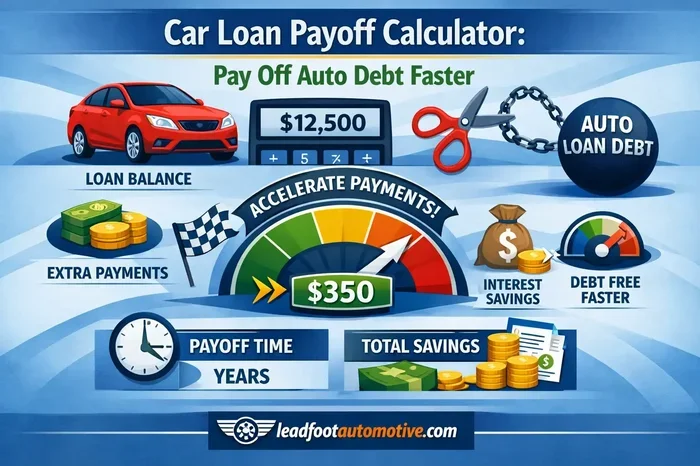
A loan payoff calculator is one of the best tools you can use. It shows you exactly how much you save when you pay off your loan early. You enter your loan amount, interest rate, and remaining term. The calculator tells you the total interest saved and the new payoff date.
Many banks and financial websites offer free calculators. Use one before you make any extra payments. It gives you a clear picture of the financial benefit.
Quick Tips to Maximize Interest Savings
- Make extra payments every month. Even $50 extra per month adds up over time.
- Make one extra payment per year. This alone can shave months off your loan term.
- Round up your payments. If your payment is $387, round up to $400.
- Apply windfalls toward your loan. Tax refunds, bonuses, and gifts can all go toward early payoff.
- Always specify principal. Tell your lender that extra payments should go toward the principal balance.
Prepayment Penalties: What to Watch Out For
Not all lenders are happy when you pay off your loan early. Some charge a prepayment penalty, also called an early payoff fee. This is a charge the lender imposes because they lose out on expected interest income when you pay off the loan ahead of schedule.
The good news is that prepayment penalties are not common anymore. Many lenders have stopped charging them. But you still need to check your loan agreement to be sure.
Types of Prepayment Penalties
There are two main types of prepayment penalties you might encounter:
- Percentage-based penalty: This is a flat percentage of your remaining balance. For example, your lender might charge 2% of the remaining balance if you pay off the loan within the first 24 months.
- Interest-based penalty: This is a set amount of interest the lender would have earned. It is usually calculated based on the remaining months of your loan term.
How to Avoid Prepayment Penalties
Here is what you can do to avoid unwanted fees:
- Read your loan agreement before signing. Look for any mention of prepayment penalties or early payoff fees.
- Ask your lender directly. Call and ask if there is a penalty for early payoff. Get the answer in writing.
- Shop around for lenders who do not charge penalties. Many online lenders offer no prepayment penalty loans.
- Wait until the penalty period ends. Some penalties only apply during the first 12 to 24 months of the loan.
Common Mistakes to Avoid
- Assuming all lenders charge penalties. Most do not. Always check, but do not assume the worst.
- Not asking about the penalty amount. If a penalty exists, know exactly how much it is before you pay off the loan.
- Paying off the loan without checking your credit report. Make sure the lender reports your loan as paid in full to the credit bureaus.
Simple Interest vs. Precomputed Interest Loans
Understanding your loan type is critical when considering early payoff. There are two main types of auto loans, and they work very differently when it comes to early payoff.
Simple Interest Loans
Most car loans today are simple interest loans. With this type of loan, interest is calculated daily based on your remaining balance. This means that when you make extra payments, you reduce the principal faster, and less interest accrues each day.
Simple interest loans are ideal for early payoff. Every extra dollar you pay goes directly toward reducing the balance, which reduces the interest you owe. If you have a simple interest loan, paying it off early is one of the best financial moves you can make.
Precomputed Interest Loans
Some older or subprime loans use precomputed interest. With this method, the lender calculates all the interest upfront and adds it to your loan balance. This means the total interest you owe is fixed from day one.
With precomputed interest loans, early payoff does not save you as much money. Since the interest was already calculated, making extra payments does not reduce the total interest you pay. You still pay off the loan faster, but the savings are minimal compared to simple interest loans.
Comparison Table
| Feature | Simple Interest Loan | Precomputed Interest Loan |
|---|---|---|
| Interest Calculation | Daily based on remaining balance | Calculated upfront and added to balance |
| Early Payoff Savings | Significant interest savings | Minimal interest savings |
| Extra Payment Impact | Reduces principal and interest | Reduces principal only |
| Common Today | Yes, most common | Less common |
| Best For | Borrowers planning early payoff | Borrowers with consistent monthly payments |
How to Find Out Your Loan Type
Check your loan agreement or call your lender. Ask, “Is my loan a simple interest or precomputed interest loan?” This single question can save you a lot of confusion and help you plan your payoff strategy.
Steps to Pay Off Your Car Loan Early
Ready to pay off your car loan ahead of schedule? Here is a step-by-step guide to help you do it the right way.
Step 1: Review Your Loan Agreement
Before you do anything else, pull out your loan agreement. Look for the payoff amount, any prepayment penalties, and the process for making extra payments. Understanding your loan terms is the foundation of a successful early payoff.
Step 2: Contact Your Lender
Call your lender and ask for the exact payoff amount. This includes any interest that has accrued up to the payoff date. Lenders often give you a payoff quote that is valid for a short period, usually 10 to 30 days.
Also ask how to make extra payments. Some lenders let you make separate payments online. Others require you to specify that extra money should go toward principal. Always make sure your extra payments are applied correctly.
Step 3: Make a Payoff Plan
Create a realistic plan for paying off your loan early. Here are some strategies:
- Lump sum payment: Use a savings bonus or windfall to pay off the remaining balance in one go.
- Extra monthly payments: Add $50 to $200 to your regular monthly payment each month.
- Bi-weekly payments: Pay half your monthly payment every two weeks. This results in 13 full payments per year instead of 12.
- Round up method: Round your payment up to the nearest $50 or $100.
Step 4: Track Your Progress
Keep an eye on your loan balance as you make extra payments. Most lenders offer online account portals where you can see your remaining balance and payment history. Watching your balance shrink is incredibly motivating.
Step 5: Get Proof of Payoff
Once your loan is paid off, get written confirmation from your lender. This document proves that your loan is satisfied in full. Keep it in a safe place with your other financial records.
Expert Insights
“Paying off a car loan early is one of the fastest ways to improve your personal finances,” says financial advisor Sarah Mitchell. “But do your homework first. Know your loan type, check for penalties, and make sure your lender reports to the credit bureaus correctly.”
Quick Tips for a Smooth Payoff
- Always get a written payoff quote before sending money.
- Make your final payment on a day when interest has not yet accrued for that month.
- Confirm that your lender will release the lien on your car title after payoff.
- Check your credit report 30 to 60 days after payoff to ensure the account shows as paid in full.
Is Paying Off a Car Loan Early Right for You?
Paying off your car loan early is a great goal, but it is not the right move for everyone. Before you commit extra money to your loan, consider your full financial picture.
When Early Payoff Makes Sense
- You have a high interest rate loan (7% or higher)
- You have no high-interest debt (like credit card balances)
- Your emergency fund is fully funded
- You want to reduce monthly expenses and improve cash flow
- Your lender does not charge a prepayment penalty
- You have a simple interest loan
When Early Payoff May Not Be the Best Move
- Your loan has a very low interest rate (below 3%)
- You have no emergency savings fund
- You have high-interest credit card debt
- Your lender charges a steep prepayment penalty
- You have retirement accounts with a good employer match that you are not fully contributing to
- The money could earn a higher return if invested elsewhere
Consider the Opportunity Cost
Sometimes, keeping your loan and investing the extra money makes more sense. If your loan has a 3% interest rate but you can earn 7% in the stock market, you are better off making minimum payments and investing the difference. This is called the opportunity cost of paying off debt early.
Every financial situation is unique. What works for one person may not work for another. Think about your goals, your risk tolerance, and your overall financial health before making a decision.
Impact on Your Credit Score
Paying off your car loan early can have both positive and negative effects on your credit score. On the positive side, it reduces your debt and improves your credit utilization ratio. It also shows that you managed your loan responsibly.
On the negative side, paying off an installment loan early can slightly lower your credit score in the short term. This happens because you lose the benefit of a diverse credit mix. However, this effect is usually temporary and minor.
The long-term benefits of being debt-free far outweigh any small, short-term dip in your credit score. A paid-off car loan means more money in your pocket every month, which is always a good thing.
Common Mistakes People Make When Paying Off a Car Loan Early
- Not checking for prepayment penalties. Always verify this before making a large payoff payment.
- Forgetting to release the lien. Your lender must release the lien on your car title. Follow up to make sure this happens.
- Not updating your insurance. Some lenders require full coverage while you have a loan. After payoff, you may be able to adjust your coverage and lower your insurance premiums.
- Making extra payments without specifying principal. If you do not tell your lender that extra money goes toward principal, it may be applied to interest instead.
- Paying off the loan and having no emergency fund. Do not drain your savings to pay off the loan. Keep some cash reserved for unexpected expenses.
Expert Tips for a Successful Early Payoff
Financial experts agree that paying off your car loan early is a smart move for most people. Here are some tips from the pros:
- Start small. Even adding $25 to your monthly payment makes a difference over time.
- Automate your extra payments. Set up automatic transfers so you never forget to make an extra payment.
- Celebrate milestones. When you hit the halfway point, reward yourself (within reason).
- Stay motivated. Keep your goal in mind. Imagine the freedom of having no car payment every month.
- Reinvest the savings. Once your loan is paid off, take the money you were using for car payments and put it into savings or investments.
Conclusion
Can you pay off a car loan early? Absolutely. And the savings can be significant. By paying off your auto loan ahead of schedule, you reduce the total interest you pay, free up monthly cash flow, and move closer to being completely debt-free.
Just remember to check your loan agreement for prepayment penalties, understand your loan type, and make sure extra payments are applied to your principal balance. Use a loan payoff calculator to see exactly how much you can save. And always consider your overall financial picture before making a big payoff decision.
Paying off your car loan early is one of the best things you can do for your financial health. It takes discipline, but the reward is worth it. Start today, make a plan, and take control of your debt. Your future self will thank you.
Frequently Asked Questions
Is it better to pay off a car loan early or make extra payments over time?
Both approaches save you money, but the lump sum payoff gives you the biggest interest savings. Making extra payments over time also works well and is easier on your budget. Choose the method that fits your financial situation best.
Will paying off my car loan early hurt my credit score?
It might cause a small, temporary dip in your credit score. This happens because you lose the benefit of an active installment loan. However, the long-term positive effects of being debt-free usually outweigh this small impact.
How long does it take to get a car loan payoff quote?
Most lenders provide a payoff quote within one to two business days. You can usually get it online through your account portal or by calling your lender directly.
Can I pay off my car loan early with a personal loan?
Yes, you can use a personal loan to pay off your car loan early. However, make sure the personal loan has a lower interest rate than your car loan. Otherwise, you may not save any money.
Do I need to notify my insurance company after paying off my car loan?
Yes, you should contact your insurance provider after payoff. You may be able to remove comprehensive or collision coverage, which can lower your monthly premiums.
What happens to my car title after I pay off the loan early?
Your lender will send you a lien release document. This proves that the loan is paid in full. You can then use this document to get a clean title from your state’s Department of Motor Vehicles.