Correct Tire Pressure for Mazda 3 The Ultimate Guide
Knowing the correct tire pressure for Mazda 3 models is essential for safety, fuel economy, and tire longevity. This guide covers PSI recommendations for every trim, model year, and driving condition. You will learn how to check, adjust, and maintain proper tire pressure with simple, step-by-step instructions.
Driving a Mazda 3 is a great experience. The car handles well, gets good gas mileage, and feels solid on the road. But there is one simple thing that many drivers overlook. Tire pressure matters more than most people think. Keeping your tires at the correct tire pressure for Mazda 3 can change everything. It affects how your car drives, how safe it is, and even how much money you spend at the pump.
In this guide, we will walk you through everything you need to know. We will cover the recommended PSI for different Mazda 3 trims. We will explain how to check your tire pressure the right way. We will also share tips that help you avoid common mistakes. Whether you own a 2014 model or a 2024 model, this guide has you covered.
The correct tire pressure for Mazda 3 is not just a number. It is a key part of taking care of your car. When your tires are inflated properly, they last longer. Your car uses less fuel. And you stay safer on the road. Let us dive in and make sure your Mazda 3 tires are set up right.
Key Takeaways
- Correct tire pressure for Mazda 3 typically ranges between 32 and 35 PSI depending on the trim and model year.
- Always check tire pressure when tires are cold for the most accurate reading.
- Underinflated tires reduce fuel economy and cause uneven tire wear on the outer edges of the tread.
- Overinflated tires give a harsh ride and wear down the center of the tread faster.
- The tire pressure monitoring system (TPMS) light is your first warning sign of a problem.
- Check your owner manual or the driver-side door jamb sticker for factory-recommended specs.
- Seasonal temperature changes affect tire pressure, so recheck every few weeks.
📑 Table of Contents
What Is the Correct Tire Pressure for Mazda 3?
The recommended tire pressure for a Mazda 3 varies slightly depending on the model year and trim level. Most Mazda 3 models use a standard range of 32 to 35 PSI. This is the number you will find on the tire pressure label located on the driver-side door jamb. Some models with larger wheels or different tire sizes may have slightly different requirements.
Here is a simple breakdown of what to expect:
- Mazda 3 base models (2014-2018): 32 PSI front and rear
- Mazda 3 Sport and i Touring trims: 33 PSI front and rear
- Mazda 3 GT and Grand Touring trims: 33-35 PSI depending on load
- 2019 and newer Mazda 3 models: 32-35 PSI, check the door jamb sticker
These numbers are general guidelines. Always refer to your specific owner manual for the exact tire pressure specs for your car. The factory engineers tested every trim and model year to find the ideal pressure. They balanced ride comfort, handling, and safety when they set those numbers.
Why the Door Jamb Sticker Matters
The sticker on your driver-side door jamb is your best friend. It tells you the exact tire pressure your Mazda 3 needs. Some people ignore it and look at the tire sidewall instead. The sidewall number is the maximum pressure the tire can handle. That is not the same as the recommended pressure for your car. Always go by what the door jamb sticker says.
How to Check Your Mazda 3 Tire Pressure
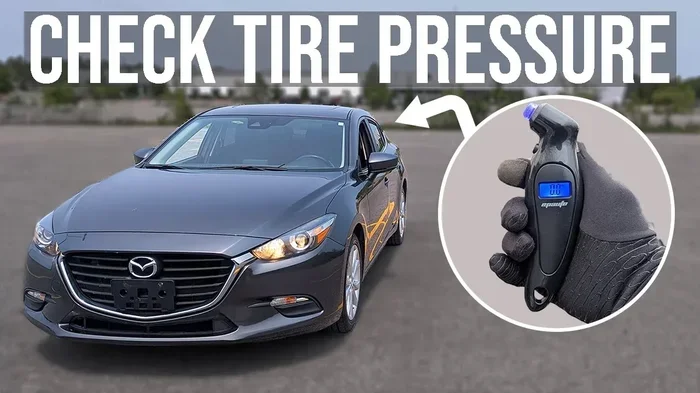
Checking your tire pressure is easy. You do not need to be a mechanic. All you need is a tire pressure gauge. These gauges cost just a few dollars at any auto parts store. You can also find them at gas stations, but your own gauge is more reliable.
Follow these simple steps to get an accurate reading:
- Check your tire pressure when the tires are cold. This means the car has been parked for at least three hours or driven less than a mile.
- Remove the valve cap from the tire valve stem.
- Press the tire pressure gauge firmly onto the valve stem.
- Read the number on the gauge. Compare it to the recommended PSI for your Mazda 3.
- Add air if the pressure is low. Let out air if it is too high.
- Replace the valve cap when you are done.
When to Check Your Tire Pressure
Make it a habit to check your tire pressure at least once a month. Tires naturally lose air over time. A tire can lose about 1 PSI per month. Temperature changes also play a big role. In cold weather, tire pressure drops. In hot weather, it rises. If you live in a place with big seasonal temperature swings, check your tires more often.
A quick tire pressure check takes only about five minutes. Set a reminder on your phone if you need to. Your tires will thank you. And your wallet will too.
Using the Tire Pressure Monitoring System
Most newer Mazda 3 models come with a tire pressure monitoring system, or TPMS. This system uses sensors inside each tire to track the air pressure. When the pressure drops below the safe level, a warning light appears on your dashboard. The light looks like a horseshoe shape with an exclamation point in the middle.
The TPMS light is helpful. But it is not perfect. It usually only activates when the pressure is 25% below the recommended level. By that point, your tires are already underinflated enough to cause problems. Do not wait for the light to come on. Check your tire pressure regularly with a gauge instead.
Why Tire Pressure Matters for Your Mazda 3
You might wonder why tire pressure gets so much attention. The truth is that proper tire inflation affects more than just your tires. It touches almost every part of your driving experience. Let us look at the main reasons why getting the correct tire pressure for Mazda 3 matters so much.
Safety First
Tires are the only part of your car that touches the road. When tire pressure is off, your grip suffers. Underinflated tires have a larger contact patch. This means more rubber meets the road, which leads to overheating. Overheated tires are more likely to blow out, especially at highway speeds. Overinflated tires, on the other hand, have a smaller contact patch. They ride on the center of the tread and reduce traction on wet roads.
Both situations are dangerous. Keeping your Mazda 3 tire pressure at the factory-recommended level gives you the best grip in all conditions. Rain, snow, or sunshine, proper inflation keeps you safer.
Fuel Economy and Cost Savings
Did you know that underinflated tires can lower your gas mileage? Studies show that tires underinflated by just 10 PSI can reduce fuel efficiency by up to 3%. That might not sound like a lot. But over time, it adds up. If you drive 12,000 miles a year, even a small drop in fuel economy means spending more money at the pump.
On the flip side, tires at the correct tire pressure for Mazda 3 roll more easily. Less rolling resistance means your engine does not work as hard. You save fuel. You save money. It is a win-win.
Tire Life and Even Wear
Tires are not cheap. A good set of tires for a Mazda 3 can cost anywhere from 400 to 800 dollars or more. You want them to last as long as possible. Proper tire inflation is one of the easiest ways to extend tire life.
Underinflated tires wear out on the outer edges of the tread. Overinflated tires wear down the center. Both patterns mean you need new tires sooner than you should. When your Mazda 3 tire pressure is right, the tread wears evenly. You get more miles out of every set of tires.
Mazda 3 Tire Pressure by Trim Level and Model Year
Not all Mazda 3 models are the same. The correct tire pressure can vary based on your trim level, engine type, and model year. Here is a closer look at what to expect across different versions of the Mazda 3.
2014 to 2018 Mazda 3
The fourth-generation Mazda 3 was a popular model. Most trims during this period used a tire pressure of 32 PSI for both the front and rear tires. The Sport and Touring trims with 18-inch wheels sometimes recommend 33 PSI. Always double-check the sticker on your door jamb to confirm.
2019 to 2024 Mazda 3
The fifth-generation Mazda 3 brought some updates. The recommended tire pressure for these models generally falls between 32 and 35 PSI. The Skyactiv-G engine models and the hatchback versions may have slightly different specs. The 2019 Mazda 3 manual lists the exact numbers for each trim. Newer models also feature a more sensitive TPMS that gives you earlier warnings.
Mazda 3 with Larger Wheels
If your Mazda 3 has 18-inch or larger wheels, the tire pressure may differ from the standard setup. Larger wheels often use lower-profile tires. These tires can handle slightly different pressure levels. Check your owner manual or the door jamb sticker to confirm the correct PSI. When in doubt, go with what the manufacturer recommends.
| Model Year | Trim | Front PSI | Rear PSI |
|---|---|---|---|
| 2014-2018 | Base / Sport | 32 | 32 |
| 2014-2018 | Touring / Grand Touring | 33 | 33 |
| 2019-2024 | Base / Sport | 32 | 32 |
| 2019-2024 | Touring / Grand Touring | 33-35 | 33-35 |
Use this table as a starting point. But always verify with your specific vehicle. The door jamb sticker is the final word on tire pressure for your Mazda 3.
Common Tire Pressure Problems and How to Fix Them
Even if you check your tire pressure regularly, problems can still happen. Knowing what to look for helps you catch issues early. Here are the most common Mazda 3 tire pressure problems and how to fix them.
Slow Air Leaks
A slow leak is one of the most common tire pressure issues. A tiny nail or screw can pierce the tire and let air out slowly. You might not notice it for days or even weeks. If you find that you need to add air to your Mazda 3 tires more often than usual, get them inspected. A tire shop can find the leak and patch or plug the tire.
TPMS Light Keeps Coming On
If your tire pressure monitoring system light stays on even after you inflate your tires, there might be a sensor issue. The TPMS sensors have batteries that eventually die. A dead sensor cannot send accurate readings. Take your Mazda 3 to a dealer or tire shop to have the sensors checked. Replacing a TPMS sensor is usually quick and affordable.
Seasonal Pressure Drops
Cold weather causes tire pressure to drop. For every 10-degree drop in temperature, your tires can lose about 1 PSI. This is why many drivers notice the TPMS light coming on in winter. If the light comes on during a cold snap, add air to bring the pressure back up. It is a simple fix that takes just a few minutes.
Overinflation from Gas Station Air Pumps
Gas station air pumps can be tricky. The gauges on those machines are not always accurate. It is easy to overinflate your tires if you are not careful. Add air in small bursts. Check the pressure frequently. If you overinflate, press the valve stem gently to release a little air. Then recheck the pressure.
Valve Stem Damage
The valve stem is the small tube on your wheel that the air goes in and out of. Over time, valve stems can crack or leak. Old valve stems are a common cause of slow air loss. Replacing a valve stem is inexpensive. Many tire shops will do it for free when you buy new tires.
Expert Tips for Maintaining Perfect Tire Pressure
Keeping your Mazda 3 tires at the right pressure does not have to be a chore. A few simple habits make a big difference. Here are some expert tips that work for real drivers.
Buy a good tire pressure gauge. The pencil-style gauges at gas stations are often inaccurate. A digital or dial gauge from an auto parts store gives you a much more reliable reading. Look for one that costs between 10 and 20 dollars.
Check your spare tire too. It is easy to forget about the spare. But a spare tire with low pressure is useless when you need it. Check the spare every few months and keep it inflated to the pressure listed in your owner manual.
Reset your TPMS after adjusting pressure. If you add or release air and the TPMS light stays on, you may need to reset the system. In most Mazda 3 models, you can reset the TPMS by pressing a button in the steering wheel or going through the infotainment menu. Refer to your owner manual for the exact steps.
Rotate your tires regularly. Tire rotation helps your tires wear evenly. Most experts recommend rotating your Mazda 3 tires every 5,000 to 7,500 miles. Even with perfect tire pressure, uneven wear can happen if you do not rotate.
Look at your tires visually. Get in the habit of visually inspecting your tires once a week. Look for bulges, cracks, or objects stuck in the tread. Catching a problem early can save you from a flat tire on the highway.
Keep a tire pressure log. This might sound like overkill, but it works. Write down your tire pressure readings each month. Over time, you will notice patterns. If one tire consistently loses more air than the others, you know there is a leak that needs attention.
Quick Tips for the Road
- Carry a portable tire inflator in your trunk. It is a small investment that can save you on the side of the road.
- Know where the nearest air pump is on your regular route.
- Do not rely on the TPMS alone. Use a manual gauge at least once a month.
- Check tire pressure before long road trips.
- Keep a copy of your Mazda 3 tire pressure specs in your glove box.
Conclusion
The correct tire pressure for Mazda 3 is one of the simplest and most important things you can do for your car. It keeps you safe on the road. It improves your fuel economy. And it helps your tires last longer. With the right PSI, your Mazda 3 drives the way it was meant to drive.
Make tire pressure checks a regular part of your car care routine. It takes just a few minutes each month. The payoff is huge. You stay safe. You save money. And you enjoy a better driving experience every time you get behind the wheel.
Now that you know the correct tire pressure for Mazda 3, take a few minutes today. Check your tires. Adjust the pressure if needed. Your Mazda 3 will reward you with a smoother, safer, and more efficient ride.
Frequently Asked Questions
What is the correct tire pressure for a Mazda 3?
The correct tire pressure for Mazda 3 models typically ranges between 32 and 35 PSI. The exact number depends on your trim level, model year, and tire size. Always check the sticker on your driver-side door jamb or your owner manual for the factory-recommended PSI.
How often should I check my Mazda 3 tire pressure?
You should check your Mazda 3 tire pressure at least once a month. Tires naturally lose about 1 PSI per month. Cold weather can cause even faster pressure loss. Making it a monthly habit keeps your tires in great shape.
Can I drive on the highway with low tire pressure?
Driving on low tire pressure is not safe. Underinflated tires overheat, which increases the risk of a blowout. If your TPMS light comes on, pull over safely and check your tire pressure. Add air to the recommended PSI before driving long distances.
Where can I find the tire pressure specs for my Mazda 3?
The tire pressure specs for your Mazda 3 are listed on the driver-side door jamb sticker. You can also find them in your owner manual. The door jamb sticker includes the recommended PSI for both front and rear tires.
Does tire pressure change with temperature?
Yes, tire pressure changes with temperature. For every 10-degree drop in outside temperature, your tires can lose about 1 PSI. This is why winter months often trigger the TPMS light. Check your tire pressure more frequently during seasonal changes.
What should I do if my TPMS light stays on after inflating my tires?
If the TPMS light stays on after you inflate your tires to the correct Mazda 3 tire pressure, the sensor may need resetting. Most Mazda 3 models let you reset the TPMS through the steering wheel controls or the infotainment system. If the light still does not go off, have the TPMS sensors checked at a tire shop or dealership.