How Much Charge Do You Get from Regenerative Braking
Regenerative braking recovers energy during deceleration and sends it back to your EV battery. Most drivers can expect a 10% to 30% boost in range depending on driving conditions. The amount of charge you gain depends on speed, battery level, temperature, and how often you brake.
If you drive an electric vehicle, you have probably noticed that slowing down actually gives your car energy. This clever process is called regenerative braking. Instead of wasting all that forward motion, your car captures it and feeds it back into the battery charge. But here is the big question most EV drivers ask: how much charge do you get from regenerative braking?
The answer is not a single number. It depends on many things like your speed, battery level, temperature, and driving habits. In this guide, we will break down everything you need to know about brake energy regeneration. You will learn how the system works, what percentage of charge you can realistically expect, and simple tips to get the most out of every stop.
Whether you own a hybrid vehicle or a fully electric car, understanding regenerative braking efficiency can help you drive farther and charge less. Let us dive into the details and make sense of this amazing technology.
Key Takeaways
- Regenerative braking recovers kinetic energy and converts it into stored battery charge while you slow down.
- Typical charge recovery ranges from 10% to 30% of your total energy use, varying by vehicle and driving style.
- Factors like speed, battery state of charge, temperature, and road terrain heavily influence how much energy you recapture.
- One-pedal driving maximizes regen benefits and reduces wear on traditional friction brakes.
- Cold weather reduces regen efficiency because batteries accept charge more slowly when they are cold.
- Regenerative braking does not fully replace friction brakes — both systems work together for safe stopping.
- Simple driving habits like coasting early and using lower regen modes can significantly boost your recovered energy.
📑 Table of Contents
- What Is Regenerative Braking and How Does It Work?
- How Much Charge Can You Actually Get from Regenerative Braking?
- Regenerative Braking Efficiency: What the Numbers Say
- Does Regenerative Braking Replace Traditional Brakes?
- Tips to Maximize Charge from Regenerative Braking
- Common Mistakes People Make with Regenerative Braking
- The Future of Regenerative Braking Technology
- Conclusion
What Is Regenerative Braking and How Does It Work?
The Basic Science Behind It
Every moving car has kinetic energy. That is the energy of motion. When you hit the brakes in a regular car, that energy turns into heat and disappears into the air. It is gone forever. That is a waste.
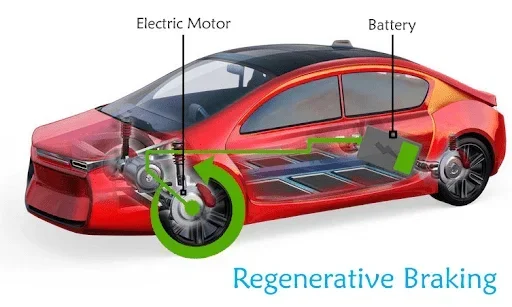
Regenerative braking works differently. Your electric motor flips roles when you take your foot off the accelerator. Instead of using electricity to spin the wheels, it uses the spinning wheels to generate electricity. That electricity flows back into the battery pack and stores energy for later use.
Think of it like a wind turbine. The wind spins the turbine, and the turbine creates electricity. In your car, the road spins the wheels, and the motor creates electricity. It is a smart cycle that keeps your driving range longer between charges.
How the Electric Motor Becomes a Generator
Here is a simple way to picture it. When you cruise at 45 miles per hour, the motor pushes the car forward using electricity. When you lift your foot off the pedal, the wheels keep spinning. Those spinning wheels now turn the motor in reverse. The reversed motor acts as a generator.
The generator creates resistance. That resistance slows the car down. At the same time, it produces electrical current. That current travels to the battery. The battery stores it as usable charge. This entire process happens in a fraction of a second. You barely notice it, but your car is quietly refueling itself every time you slow down.
This is why many EV owners love one-pedal driving. You can slow down and stop without ever touching the brake pedal. The regen system handles most of the deceleration. It feels smooth and intuitive once you get used to it.
How Much Charge Can You Actually Get from Regenerative Braking?
Typical Charge Recovery Rates
So, what is the real number? On average, regenerative braking recovers about 10% to 30% of the energy you used during a trip. Some conditions push that number higher. Other conditions bring it way down. Let us look at some realistic scenarios.
If you drive in a city with lots of stop-and-go traffic, you get a lot of opportunities to recapture energy. Every time you slow down for a light or a car, the system grabs some deceleration energy. City drivers often see the upper end of that 10% to 30% range. On the highway, there are fewer stops, so the recovery drops closer to the lower end.
Here is a quick look at what you might expect in different situations:
- City driving with heavy traffic: 20% to 30% charge recovery
- Suburban driving with moderate stops: 15% to 25% charge recovery
- Highway driving with few stops: 5% to 15% charge recovery
- Mountain roads with downhill sections: 25% to 40% charge recovery
These numbers are estimates. Your actual results will vary. But they give you a solid idea of what to expect from energy recovery during normal daily driving.
Factors That Affect Energy Recovery
Several key factors determine how much battery charge you actually recover. Understanding these can help you adjust your driving to get more energy back.
Speed matters a lot. The faster you are going when you brake, the more kinetic energy there is to capture. Braking from 60 mph recovers far more energy than braking from 20 mph. This is why highway exits and busy intersections are prime moments for charge recovery.
Battery state of charge also plays a role. If your battery is nearly full, it cannot accept as much incoming energy. The system backs off regen to protect the battery. This is similar to how a phone slows down charging when it reaches 90%. So if your state of charge is already high, you will recover less energy during braking.
Temperature affects everything. Cold batteries are sluggish. They resist accepting charge quickly. In winter, your regenerative braking efficiency can drop by 20% to 40%. Warm batteries accept charge much more readily. This is why many EV owners notice better regen performance on warm summer days.
Road terrain is another factor. Driving downhill gives you long, gentle deceleration. That extended slowing period lets the system harvest energy over a longer time. Flat roads and uphill driving offer fewer opportunities. Hilly routes can significantly boost your overall energy recovery.
Regenerative Braking Efficiency: What the Numbers Say
Comparing Different EV Models
Not all electric vehicles recover energy at the same rate. Different brands and models use different regenerative braking systems with varying levels of efficiency. Here is a quick comparison of popular EV models and their typical regen performance.
- Tesla Model 3: Recovers up to 70% of kinetic energy during deceleration in optimal conditions.
- Nissan Leaf: Offers strong regen with about 60% to 65% recovery rate in city driving.
- Chevrolet Bolt EV: Achieves around 60% regen efficiency under normal city conditions.
- Hyundai Kona Electric: Provides adjustable regen levels with up to 68% recovery potential.
- Porsche Taycan: Uses advanced two-speed regen for up to 75% recovery during aggressive deceleration.
These numbers reflect lab conditions and ideal scenarios. Real-world results are usually a bit lower. But they show that modern EV technology has made incredible progress in brake energy regeneration.
Real-World vs. Lab Conditions
It is important to understand that lab tests and real-world driving are very different. In a lab, engineers control every variable. The temperature is perfect. The road is flat. The driver follows a precise pattern. In the real world, things are messier.
Traffic lights, other drivers, weather changes, and road conditions all affect how much energy you actually recover. A smooth, predictable driver in a city will recover more energy than someone who brakes hard and late. Regenerative braking efficiency is not just about the car. It is also about how you drive it.
Most EV owners find that their real-world recovery sits around 15% to 25% of total energy used. That may not sound like a lot, but over thousands of miles, it adds up to meaningful extra range and fewer charging stops.
Does Regenerative Braking Replace Traditional Brakes?
When Friction Brakes Still Kick In
Here is something many new EV drivers wonder about. If regen handles all the slowing down, do you even need regular brakes? The answer is yes. You still need friction brakes, and here is why.
Regenerative braking has limits. It cannot provide the instant, full stopping power that emergency situations demand. At very low speeds, below about 5 mph, most regen systems shut off. You need friction brakes to bring the car to a complete stop. Wet or icy roads also reduce regen effectiveness, so the friction brakes take over more often in those conditions.
Over time, this is actually great news for your maintenance. Because regen handles most of your everyday slowing down, your brake pads and rotors wear out much more slowly. Many EV owners report replacing brake pads every 100,000 miles or more. That is a huge savings compared to traditional cars.
One-Pedal Driving Explained
One-pedal driving is the practice of using only the accelerator pedal to control your speed. You press down to go. You lift up to slow down and stop. The regen system handles all the deceleration.
It takes a few days to get comfortable with this driving style. At first, it feels strange to slow down just by lifting your foot. But once you adjust, many drivers say they never want to go back. One-pedal driving is smoother, more efficient, and reduces wear on your friction brakes.
To get the most charge recovery from one-pedal driving, try to lift off the accelerator early. Give yourself plenty of time to slow down gradually. Abrupt lifts can cause the car to decelerate too quickly and waste some of the recoverable energy. Smooth, early lifting is the key.
Tips to Maximize Charge from Regenerative Braking
Driving Habits That Boost Recovery
You do not need to buy a new car to get more from regenerative braking. Simple changes to how you drive can make a big difference. Here are some habits that help you recover more energy.
- Lift off the accelerator early. The sooner you start slowing down, the more time the regen system has to capture energy. Coasting toward red lights is one of the best habits you can build.
- Avoid hard braking when possible. Slamming the brakes wastes kinetic energy as heat. Gentle, gradual deceleration lets the motor recover more of that energy.
- Use downhill stretches to your advantage. Long downhill grades let the regen system work continuously. This is where you can see the highest recovery rates.
- Keep a safe following distance. More space means more time to coast and decelerate gently. It also makes driving safer and less stressful.
- Plan your routes with traffic in mind. Stop-and-go traffic is actually your friend when it comes to energy recovery. More stops mean more opportunities to recharge.
Settings and Features to Enable
Most modern electric vehicles come with adjustable regen settings. Take a few minutes to explore your car’s menu. You might find options like low, standard, and high regen modes.
High regen mode gives you the most aggressive energy recovery. It slows the car down more when you lift off the pedal. This maximizes charge recovery but can feel jerky if you are not used to it. Start with standard mode and work your way up.
Some cars also offer battery preconditioning features. These warm up the battery before a trip so it can accept charge more efficiently. If your car has this feature, use it especially in cold weather. It directly improves your regenerative braking efficiency.
Common Mistakes People Make with Regenerative Braking
Over-Reliance on Regen
The biggest mistake is thinking that regenerative braking will solve all your charging needs. It is a helpful supplement, not a replacement for plugging in. Even the best regen system cannot fully recharge your battery from empty. You still need to connect to a charger regularly.
Another mistake is ignoring the regen indicator on your dashboard. Many EVs show a real-time display of energy flowing back to the battery. Watching this gauge helps you understand when and how much energy you are recovering. Use it as a learning tool to adjust your driving style.
Ignoring Brake Maintenance
Because regen reduces wear on friction brakes, some drivers forget about them entirely. This is a mistake. Your brake fluid, pads, and rotors still need regular inspection. The regen system handles most of the work, but the friction brakes are still essential for safety.
Schedule brake checks as part of your regular EV maintenance routine. A quick inspection every 10,000 to 15,000 miles keeps everything in top shape. It also ensures that both systems work together seamlessly when you need them most.
The Future of Regenerative Braking Technology
Regenerative braking technology is improving every year. Car makers are finding new ways to capture more energy and recover it faster. Some manufacturers are experimenting with two-motor setups that recover energy from both axles simultaneously. This doubles the potential energy recovery during braking.
Other companies are working on predictive regen systems. These use GPS and navigation data to anticipate stops ahead of time. The car starts regenerating early based on upcoming traffic lights or curves. This smart approach maximizes charge recovery before you even begin slowing down.
Solid-state batteries are also on the horizon. These next-generation batteries accept charge faster and more efficiently. They could dramatically improve how much energy your car captures during regenerative braking. The combination of smarter regen systems and better batteries means the future looks very bright for EV owners.
Some automakers are even exploring vehicle-to-grid technology. This lets your car send stored energy back to the power grid during peak demand. It is an exciting extension of the energy recovery concept that started with regenerative braking. The more we understand about capturing and storing energy, the more efficient our electric vehicles become.
Conclusion
Regenerative braking is one of the smartest features in modern electric vehicles. It turns wasted energy into usable battery charge and helps you drive farther on every trip. Most drivers recover between 10% and 30% of their energy through regen, and smart driving habits can push that number even higher.
The amount of charge you get from regenerative braking depends on speed, battery level, temperature, terrain, and how you drive. There is no single magic number. But understanding the factors gives you the power to maximize your results. Use the tips in this guide, adjust your driving style, and explore your car’s settings to get the most from every stop.
Remember, brake energy regeneration is a supplement to regular charging, not a replacement. Keep plugging in, keep driving smart, and enjoy the benefits of this incredible technology. The more you understand how your car recovers energy, the more you can squeeze out of every kilowatt-hour.
Frequently Asked Questions
Does regenerative braking work when the battery is full?
No, most EV systems reduce or disable regen when the battery reaches near-full capacity. The battery cannot accept more charge safely. Once you use some energy and the state of charge drops, regen becomes available again.
Can regenerative braking fully charge your EV battery?
No, regenerative braking alone cannot fully charge your battery. It recovers a portion of the energy you already used. Think of it as a way to extend your range, not a substitute for plugging in your car.
Why does regenerative braking feel weaker in cold weather?
Cold batteries resist accepting charge quickly. The regenerative braking system reduces power output to protect the battery. As the battery warms up during driving, regen performance improves and returns to normal levels.
Does one-pedal driving save brake pad wear?
Yes, one-pedal driving significantly reduces the use of friction brakes. Because the regen system handles most deceleration, your brake pads and rotors last much longer. Many EV owners go over 100,000 miles before needing a brake pad replacement.
How can I check how much charge my regen system is recovering?
Most electric vehicles display real-time energy flow on the dashboard or in the infotainment system. Look for a battery icon with an arrow pointing inward or a charge recovery indicator. This shows you the energy flowing back to the battery during deceleration.
Is regenerative braking safe for the battery long-term?
Yes, regenerative braking is safe and actually beneficial for battery health. It keeps the battery active and within its optimal operating range. The car’s battery management system carefully controls the charge rate to prevent any damage from energy recovery.
=== CONCLUSION ===
How much charge do you get from regenerative braking? The honest answer is it depends, but it is always worth understanding. With typical recovery rates between 10% and 30%, regenerative braking adds meaningful range to every trip. Factors like speed, temperature, battery level, and driving habits all shape your actual results.
The best thing you can do is stay mindful of how you drive. Coast early, brake gently, and use your car’s regen settings to your advantage. Over time, these small habits compound into real savings on charging costs and extra miles on your odometer.
Regenerative braking is not just a tech feature. It is a way of thinking about energy differently. Every slowdown is an opportunity. Every descent is a free recharge. Embrace it, and you will get more out of your electric vehicle every single day.