Is There a Pattern for Rotating Tires on Your Vehicle
Yes, there is a specific pattern for rotating tires, and following it correctly can extend your tire life by up to 30 percent. The right tire rotation pattern depends on your vehicle type, drivetrain, and tire design. In this guide, we break down every rotation pattern so you can keep your tires wearing evenly and your ride smooth.
Is there a pattern for rotating tires? The short answer is yes. But the full answer is a bit more detailed, and it matters a lot if you want your tires to last and your car to handle well.
Every vehicle has a recommended tire rotation pattern that helps spread wear evenly across all four tires. When you skip or mess up the pattern, you end up with tires that wear down faster on one side. That means a shorter tire lifespan, poorer fuel economy, and even safety risks on the road.
In this article, we will walk through every tire rotation pattern you need to know. We will cover front-wheel drive, rear-wheel drive, all-wheel drive, and directional tires. By the end, you will know exactly which pattern fits your vehicle and how to rotate your tires like a pro.
Key Takeaways
- Different vehicles need different rotation patterns: front-wheel drive, rear-wheel drive, all-wheel drive, and directional tires all require specific approaches.
- Most drivers should rotate tires every 5,000 to 7,500 miles: sticking to a regular rotation schedule prevents uneven tread wear.
- The X-pattern, forward cross, and rearward cross are the most common patterns: each works best for a specific drivetrain type.
- Directional tires can only move front-to-back: never switch them side to side, or you risk compromising handling and safety.
- Skipping tire rotation leads to premature replacement: uneven wear means you spend more money sooner.
- Check your owner manual first: manufacturers often specify the exact rotation pattern and interval for your vehicle.
📑 Table of Contents
- Why Tire Rotation Patterns Matter
- The Most Common Tire Rotation Patterns
- Which Pattern Is Right for Your Vehicle?
- Step-by-Step Guide to Rotating Your Tires
- Common Tire Rotation Mistakes to Avoid
- When to Rotate Tires and How Often
- Comparison of Tire Rotation Patterns
- Final Thoughts on Tire Rotation Patterns
Why Tire Rotation Patterns Matter
Tires do not wear the same on every wheel position. Your front tires handle steering and most of the braking force. Your rear tires follow and help stabilize the vehicle. Because of this, the front tires wear faster than the rear tires on most cars.
Rotating your tires moves them to different positions. This lets each tire wear more evenly over time. Even tire wear means better traction, smoother rides, and fewer trips to the tire shop.
Here is why a set rotation pattern matters:
- Even tread wear: Each tire gets a turn at every position, so no single tire wears out too fast.
- Better fuel economy: Evenly worn tires roll more smoothly and reduce drag on the road.
- Improved safety: Tires with even tread grip the road better, especially in wet or icy conditions.
- Longer tire lifespan: You get more miles out of every set of tires before needing replacements.
- Better vehicle handling: Balanced tires keep your car tracking straight and responding well on turns.
Think of it like rotating crops in a garden. If you plant the same crop in the same spot every year, the soil wears out. Moving things around keeps everything healthy. Tire rotation works the same way for your wheels.
The Cost of Ignoring Tire Rotation
Skipping regular rotations might save you a little time now. But the cost adds up fast. Unevenly worn tires need replacing sooner. A full set of tires can cost anywhere from $400 to $1,000 or more. Regular rotation is a small service that saves you hundreds of dollars over the life of your tires.
Most tire shops will rotate your tires for free or charge a small fee. Many oil change packages include tire maintenance as part of the service. It is one of the easiest ways to protect your investment.
The Most Common Tire Rotation Patterns
There are several tire rotation patterns used today. The one you need depends on your drivetrain and the type of tires on your vehicle. Let us break down each pattern and explain when to use it.
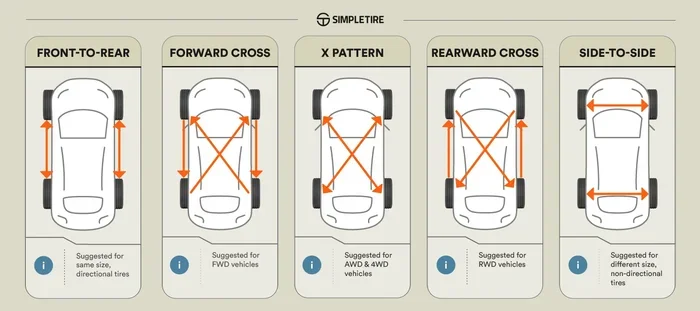
1. The Forward Cross Pattern
The forward cross is the most common pattern for front-wheel drive vehicles. In this pattern, the front tires stay on the same side but move to the rear. The rear tires cross over to the opposite front positions.
Here is how it works:
- Front left tire moves to the rear left position.
- Front right tire moves to the rear right position.
- Rear left tire moves to the front right position.
- Rear right tire moves to the front left position.
This pattern works well because front-wheel drive cars wear out their front tires faster. Moving the rear tires to the front gives them a chance to wear more slowly in a new position. The front tires move straight back, where they continue to handle the driving force.
2. The Rearward Cross Pattern
The rearward cross is the opposite of the forward cross. It is designed for rear-wheel drive and all-wheel drive vehicles. In this pattern, the rear tires stay on the same side and move to the front. The front tires cross over to the opposite rear positions.
Here is how it works:
- Rear left tire moves to the front left position.
- Rear right tire moves to the front right position.
- Front left tire moves to the rear right position.
- Front right tire moves to the rear left position.
Rear-wheel drive vehicles put more stress on the rear tires because they handle the acceleration force. The rearward cross pattern helps balance this wear by moving the rear tires forward while sending the front tires to the back on opposite sides.
3. The X-Pattern
The X-pattern works well for front-wheel drive vehicles as an alternative to the forward cross. Every tire moves to the opposite diagonal position. This pattern is simple and effective for vehicles where the tire wear is fairly even across all positions.
Here is how it works:
- Front left tire moves to the rear right position.
- Front right tire moves to the rear left position.
- Rear left tire moves to the front right position.
- Rear right tire moves to the front left position.
The X-pattern gives every tire a completely new position. It is a great choice for drivers who want a straightforward rotation method. Many people ask, is there a pattern for rotating tires that is simple and easy to remember? The X-pattern fits the bill perfectly.
4. The Side-to-Side Pattern
Some vehicles require a side-to-side swap. This pattern moves each tire directly across to the other side on the same axle. It works best for vehicles with different tire sizes on the front and rear axles, such as certain sports cars and performance vehicles.
Here is how it works:
- Front left tire moves to the front right position.
- Front right tire moves to the front left position.
- Rear left tire moves to the rear right position.
- Rear right tire moves to the rear left position.
Side-to-side rotation is not for every vehicle. It only works when the front and rear tires are the same size. Always check your owner manual or the tire placard before using this pattern.
5. The Five-Tire Rotation Pattern
If your vehicle has a full-size spare tire, you can include it in the rotation. The five-tire pattern moves every tire, including the spare, to a new position. This is the most thorough rotation method and helps all five tires wear evenly.
Here is how it works for a rear-wheel drive vehicle:
- Front left tire moves to the rear right position.
- Front right tire moves to the rear left position.
- Rear left tire moves to the front right position.
- Rear right tire moves to the front left position.
- Spare tire moves to the rear left position.
The five-tire pattern is less common, but it is worth doing if you have a matching full-size spare. It maximizes the life of every tire on your vehicle, including the one sitting in the trunk.
Which Pattern Is Right for Your Vehicle?
Choosing the right tire rotation pattern depends on three main factors: your drivetrain, your tire type, and your tire size. Let us look at each factor and how it affects your choice.
Drivetrain Type and Rotation
The drivetrain determines which tires wear faster and where they need to go during rotation.
- Front-wheel drive: Use the forward cross or X-pattern. The front tires wear faster because they handle steering and driving force.
- Rear-wheel drive: Use the rearward cross pattern. The rear tires take more of the driving force and need to be moved forward.
- All-wheel drive: Use the rearward cross or X-pattern. AWD systems distribute power to all wheels, so wear is more even but still benefits from rotation.
- Four-wheel drive: Use the rearward cross. Many 4WD vehicles have similar wear patterns to AWD systems.
Directional vs. Non-Directional Tires
This is where many drivers get confused. The type of tire you have changes what rotation patterns are safe to use.
Directional tires have a tread pattern designed to roll in one direction only. These tires have an arrow on the sidewall showing the rotation direction. You can only swap directional tires from front to back. You cannot switch them side to side because that would make them spin the wrong way.
Non-directional tires have a symmetric tread pattern. These can be moved in any direction and any position. You can use the forward cross, rearward cross, X-pattern, or side-to-side patterns with non-directional tires.
If you have directional tires, the best patterns are:
- Front-to-back on each side: Front left goes to rear left, and front right goes to rear right.
- Rear-to-front on each side: Rear left goes to front left, and rear right goes to front right.
Always check the sidewall markings before rotating. If you see an arrow, your tires are directional, and you must follow the front-to-back rule.
Different Tire Sizes Front and Rear
Some vehicles run different tire sizes on the front and rear axles. Staggered tire setups are common on performance cars and trucks. When tire sizes differ, you cannot cross the tires from one axle to the other.
In this case, your options are limited:
- Side-to-side on each axle only: Swap the front tires left to right and the rear tires left to right.
- Front-to-back on each axle only: This only works if the tire sizes match on each axle, which they do in staggered setups.
Staggered setups mean you cannot use the forward cross, rearward cross, or X-pattern. You are limited to simpler swaps. This is another reason why checking your tire size before rotating is so important.
Step-by-Step Guide to Rotating Your Tires
Rotating your tires is easier than most people think. You can do it at home with basic tools, or you can have a tire shop handle it for you. Here is a simple step-by-step guide to get it done right.
Step 1: Gather Your Tools and Supplies
Before you start, make sure you have everything you need:
- A lug wrench or tire iron
- A car jack and jack stands or ramps
- A torque wrench
- Your vehicle owner manual
- A marker or tape to label tires (optional but helpful)
Step 2: Loosen the Lug Nuts
Before you lift the car, loosen each lug nut about a quarter turn. Do not remove them yet. Loosening them while the tire is still on the ground prevents the wheel from spinning freely when you jack up the car.
Step 3: Jack Up the Vehicle
Place the jack under the vehicle at the designated jack point. Lift one wheel off the ground and place a jack stand underneath for safety. Never work under a car supported only by a jack.
Step 4: Remove the Tires
Finish removing the lug nuts and pull the tire off the hub. Set it aside in the position where it will go after rotation. Repeat for each tire you are swapping.
Step 5: Install the Tires in the New Positions
Follow the rotation pattern for your vehicle. Place each tire in its new position and hand-tighten the lug nuts. Make sure each tire seats properly on the hub before tightening fully.
Step 6: Tighten the Lug Nuts
Use a torque wrench to tighten each lug nut to the manufacturer specification. Tighten them in a star pattern to ensure even pressure. Over-tightening can warp the brake rotor, so follow the torque specs carefully.
Step 7: Lower the Vehicle and Check
Lower the car off the jack stands. Once all four tires are on the ground, give each lug nut one final check with the torque wrench. Then check your tire pressure and adjust if needed.
After rotating your tires, it is a good idea to check the wheel alignment as well. Misaligned wheels cause uneven tire wear no matter how often you rotate them. A proper alignment keeps your tires wearing evenly and your car driving straight.
Quick Tips for DIY Tire Rotation
- Mark your tires with chalk or tape before removing them so you can track which tire goes where.
- Rotate tires on a flat, level surface for safety.
- Work on one wheel at a time to avoid mixing up positions.
- Reset your tire rotation reminder in your phone or maintenance log after each rotation.
Common Tire Rotation Mistakes to Avoid
Even with the best intentions, mistakes happen. Here are the most common errors drivers make when rotating their tires, and how to avoid them.
Using the Wrong Pattern for Your Drivetrain
This is the biggest mistake. Using a forward cross on a rear-wheel drive vehicle or a rearward cross on a front-wheel drive car can actually make tire wear worse. Always match the pattern to your drivetrain type.
Forgetting About Directional Tires
Switching directional tires side to side ruins the tread pattern’s effectiveness. The tire will not channel water properly, which increases the risk of hydroplaning. Always keep directional tires rotating front to back only.
Skipping the Spare Tire
If you have a full-size matching spare, leaving it out of the rotation means it ages while the other four tires wear. A five-tire rotation ensures every tire gets equal use.
Not Checking Tire Pressure After Rotation
Moving tires around can slightly affect pressure readings. Always check and adjust tire pressure after a rotation. Proper pressure is one of the simplest ways to extend tire life.
Ignoring Uneven Wear Signs
If your tires show uneven wear even after rotation, there may be an underlying issue. Wheel alignment problems, worn suspension parts, or incorrect tire pressure can all cause uneven tread wear. Address these issues before they damage your tires further.
When to Rotate Tires and How Often
Most manufacturers recommend rotating your tires every 5,000 to 7,500 miles. However, this interval can vary based on your driving habits and vehicle type.
Here are some general guidelines:
- Front-wheel drive vehicles: Rotate every 5,000 to 6,000 miles.
- Rear-wheel drive vehicles: Rotate every 6,000 to 7,500 miles.
- All-wheel drive vehicles: Rotate every 5,000 to 7,500 miles.
- Heavy-duty trucks and SUVs: Rotate every 5,000 miles or more frequently if you tow heavy loads.
A good rule of thumb is to rotate your tires with every oil change. This keeps the interval consistent and easy to remember. Many quick-lube shops bundle tire rotation into their oil change packages, so it costs little to nothing extra.
You should also rotate your tires if you notice any of these signs:
- Uneven tread wear: One tire wears down faster than the others.
- Vibration while driving: Uneven tires can cause the steering wheel or the whole car to vibrate.
- Reduced traction: If your tires lose grip more quickly than usual, uneven wear may be the cause.
- Noisy ride: Worn tires can make more road noise, especially on smooth highways.
Catching these signs early and rotating your tires promptly can save you from a costly tire replacement. Tire safety starts with regular maintenance, and rotation is one of the simplest yet most effective steps you can take.
Expert Insights on Tire Rotation
Certified tire technicians agree that most drivers neglect tire rotation until it is too late. A routine rotation takes about 15 to 30 minutes and can add thousands of miles to your tire life. The key is consistency. Set a reminder on your phone or mark it on your calendar every 5,000 miles.
Many tire manufacturers, including Michelin, Goodyear, and Bridgestone, recommend a strict rotation schedule as part of their warranty terms. Skipping rotations can void your tire warranty, which means you would pay full price for replacements that should have been covered.
Professional mechanics also suggest pairing tire rotation with other routine maintenance. Check your tire balance every time you rotate. A balanced tire wears more evenly and provides a smoother ride. Combine rotation, balance, and alignment checks, and your tires will last their full lifespan.
Comparison of Tire Rotation Patterns
Here is a quick reference to help you choose the right pattern for your vehicle setup.
| Pattern | Best For | Directional Tires? | Staggered Setup? |
|---|---|---|---|
| Forward Cross | Front-wheel drive | No | No |
| Rearward Cross | Rear-wheel drive, AWD | No | No |
| X-Pattern | FWD or even wear | No | No |
| Side-to-Side | Staggered tire sizes | No | Yes |
| Front-to-Back Only | Directional tires | Yes | No |
| Five-Tire Rotation | Full-size matching spare | No | No |
This table gives you a fast way to identify the right pattern. If you are unsure, consult your vehicle owner manual or ask a tire professional. They can confirm the best rotation pattern for your specific setup.
Final Thoughts on Tire Rotation Patterns
So, is there a pattern for rotating tires? Absolutely. And now you know exactly which pattern works for your vehicle. Whether you drive a front-wheel commuter car, a rear-wheel performance sedan, or an all-wheel drive SUV, there is a rotation pattern designed to keep your tires wearing evenly.
The key is to stay consistent. Follow the recommended pattern for your drivetrain and tire type. Stick to a rotation schedule every 5,000 to 7,500 miles. And never ignore the signs of uneven tire wear.
Tire rotation is one of the simplest and most cost-effective maintenance tasks you can do. It takes very little time, costs very little money, and pays off in a big way. Your tires last longer. Your car handles better. And you avoid the expense of premature tire replacement.
Take a few minutes today to check your rotation schedule. If it has been a while since your last rotation, book an appointment or grab your tools and do it yourself. Your tires will thank you for it, and your wallet will too.
Frequently Asked Questions
Can I rotate my tires myself at home?
Yes, you can rotate your tires at home if you have a jack, jack stands, and a lug wrench. It is a straightforward process that takes about 30 minutes. Just make sure you follow the correct rotation pattern for your vehicle and tighten the lug nuts to the proper torque specification.
What happens if I rotate my tires too often?
Rotating your tires more often than recommended does not cause any harm. However, it is unnecessary and wastes your time. Sticking to the recommended interval of every 5,000 to 7,500 miles gives your tires the best chance to wear evenly without any extra effort.
Do I need to rotate tires if I have all-wheel drive?
Yes, all-wheel drive vehicles benefit greatly from regular tire rotation. AWD systems put stress on all four tires, and uneven wear can still occur. Use the rearward cross or X-pattern for AWD vehicles, and rotate every 5,000 to 7,500 miles.
Can I rotate tires with a full-size spare?
Yes, and it is actually recommended if your spare matches the other four tires in size and type. The five-tire rotation pattern includes the spare, ensuring all five tires wear evenly. This is the most thorough approach to tire maintenance.
How do I know if my tires are directional?
Look at the tire sidewall for an arrow showing the rotation direction. If the tire has an arrow, it is directional and can only be rotated front to back. Non-directional tires have no arrow and can be moved in any pattern.
Does tire rotation fix uneven tire wear?
Tire rotation helps prevent uneven wear from getting worse, but it cannot fix already uneven wear. If your tires are already worn unevenly, rotation will even out future wear, but you may still need to replace the more worn tires. Address alignment and suspension issues first to stop uneven wear at its source.
=== CONCLUSION ===
Is there a pattern for rotating tires? Yes, and choosing the right one makes a real difference in how long your tires last and how safely your vehicle handles. Every drivetrain type, tire design, and vehicle setup has a specific rotation pattern that works best. By following the guidelines in this article, you can keep your tire rotation schedule on track and your tires wearing evenly.
Remember to check your owner manual, match the pattern to your drivetrain, and never skip rotations. Consistent tire maintenance is the foundation of a safe, smooth, and cost-effective driving experience. Start today, and your tires will reward you with miles of reliable performance ahead.