How to Check Tire Pressure on Your 2019 Honda Civic
Checking your 2019 Honda Civic tire pressure is quick, easy, and essential for safety and fuel efficiency. This guide walks you through every step, from finding the recommended PSI to using a tire gauge and resetting the TPMS light. Whether you are a beginner or a seasoned driver, you will master tire pressure checks in minutes.
Your 2019 Honda Civic is a reliable, fun-to-drive car. But there is one simple thing that can make or break your driving experience: tire pressure. If your tires are not inflated correctly, you risk poor fuel economy, uneven tire wear, and even dangerous blowouts. The good news is that checking your tire pressure takes just a few minutes and costs almost nothing.
In this guide, we will walk you through exactly how to check tire pressure on a 2019 Honda Civic. You will learn where to find the correct PSI, which tools you need, and how to read your results like a pro. By the end, you will feel confident handling this basic but critical piece of tire maintenance on your own.
Let us get started. Your tires will thank you.
Key Takeaways
- Find the Right PSI: The 2019 Honda Civic recommended tire pressure is typically 32 PSI for all four tires, but always check your driver-side door jamb sticker.
- Check When Cold: Always measure tire pressure when the tires are cold for the most accurate reading.
- Use a Reliable Gauge: A digital or dial tire gauge gives you precise results compared to gas station air pumps.
- Reset the TPMS Light: After adjusting pressure, you can easily reset the tire pressure monitoring system on your Civic.
- Check Monthly: Make tire pressure checks a monthly habit to extend tire life and improve fuel economy.
- Don’t Ignore the Light: A flashing or persistent tire pressure warning light means immediate attention is needed.
- Keep a Portable Gauge: Having your own tire pressure gauge in the car ensures you are never caught off guard.
📑 Table of Contents
- Why Tire Pressure Matters for Your 2019 Honda Civic
- Finding the Recommended Tire Pressure for Your 2019 Honda Civic
- Tools You Need to Check Tire Pressure
- Step-by-Step Guide: How to Check Tire Pressure on Your 2019 Honda Civic
- Understanding the Tire Pressure Monitoring System (TPMS) on Your 2019 Honda Civic
- Common Tire Pressure Mistakes to Avoid
- Benefits of Regular Tire Pressure Checks
- Quick Tips for Perfect Tire Pressure Maintenance
- Conclusion
Why Tire Pressure Matters for Your 2019 Honda Civic
Tire pressure might seem like a small detail, but it affects almost every part of how your car performs. When your tires are properly inflated, they grip the road better, wear evenly, and help your engine work less hard. That means better handling, a smoother ride, and savings at the pump.
On the flip side, driving on underinflated or overinflated tires causes real problems. Underinflated tires create more rolling resistance, which forces your engine to burn more fuel. They also generate excess heat, which accelerates tire wear on the outer edges of the tread. Overinflated tires, on the other hand, give you a harsh ride and wear out the center of the tread faster than it should.
How Often Should You Check Your Tire Pressure?
The general rule is to check your tire pressure at least once a month. Air slowly leaks through tires over time, even without a puncture. Temperature changes also affect pressure. For every 10-degree drop in outside temperature, your tire pressure can decrease by about 1 PSI. So checking monthly keeps you ahead of any issues.
You should also check before long road trips. A quick five-minute check can prevent flats, improve your fuel economy, and keep your Honda Civic running safely on the highway.
Finding the Recommended Tire Pressure for Your 2019 Honda Civic
Before you grab a gauge, you need to know the correct recommended tire pressure for your specific Civic. The number is not the same for every car, and guessing can lead to problems.
Where to Find the Tire Pressure Label
On the 2019 Honda Civic, the tire pressure information is located on a sticker inside the driver-side door frame. Open your driver door and look at the vertical edge of the door. You will see a small label or sticker with tire specifications printed on it. This is called the tire pressure placard.
The sticker lists the recommended PSI for both front and rear tires. For most 2019 Honda Civic models, the number is 32 PSI. However, if you have a trim level with larger or different tires, the number may vary slightly. Always trust the door jamb sticker over anything you find online or hear from others.
What If You Cannot Find the Sticker?
No worries. You can also check your Honda Civic owner manual. The owner manual is usually kept in the glove box. Look in the index for “tire pressure” or “tires.” The manual will list the exact PSI specifications for your model. Keeping the manual in your glove box is a great habit for any car owner.
Tools You Need to Check Tire Pressure
Checking tire pressure on a 2019 Honda Civic requires just a couple of simple tools. You do not need to visit a mechanic or a tire shop. Everything you need is affordable and easy to use at home.
Tire Pressure Gauge
The most important tool is a tire gauge. There are three main types:
- Digital Tire Gauge: This is the most accurate and easiest to read. It displays the PSI number clearly on a small screen. Digital gauges usually cost between $10 and $25.
- Dial Tire Gauge: This type has a round dial face with a needle that points to the pressure reading. They are reliable and do not require batteries.
- Pencil-Type Gauge: Also called a stick gauge, this is the cheapest option. It uses a small rod that pushes out to indicate pressure. While affordable, they can be slightly harder to read precisely.
For the best experience, we recommend a digital tire gauge. It gives you fast, accurate readings every time. Keep one in your glove box so you can check your tire pressure anytime, anywhere.
Air Compressor or Air Pump
Once you know your pressure is low, you need to add air. You have a few options:
- Portable 12V Air Compressor: These plug into your car’s cigarette lighter or USB port. They are compact and perfect for emergencies or home use.
- Gas Station Air Pump: Most gas stations have coin-operated air pumps. These work well, but the pressure gauges on them are often inaccurate.
- Home Air Compressor: If you have a garage with an air compressor, this is the most convenient option for regular tire checks.
The Tire Valve Stem Cap
Do not overlook the tiny cap on your tire valve stem. It keeps dirt and moisture out of the valve core. Always replace the cap after checking your pressure. A missing cap can lead to slow air leaks over time.
Step-by-Step Guide: How to Check Tire Pressure on Your 2019 Honda Civic
Now that you have your tools and the correct PSI, let us walk through the process step by step. This is the same process recommended by Honda for all Civic owners.
Step 1: Check Pressure When Tires Are Cold
Always check your tire pressure when the tires are cold. This means the car has been parked for at least three hours or driven less than a mile. Driving heats up the air inside the tires, which raises the pressure reading. A cold reading gives you the most accurate baseline for your tire pressure check.
Step 2: Remove the Valve Stem Cap
Locate the valve stem on your tire. It is the small metal or rubber protrusion on the inside of the wheel. Unscrew the cap by turning it counterclockwise. Set the cap aside in a safe place so you do not lose it.
Step 3: Press the Gauge Firmly onto the Valve Stem
Place your tire gauge squarely onto the valve stem. Push down firmly and hold it in place. You should hear a brief hiss of air escaping, but the gauge will still give you a reading. With a digital gauge, the screen will display the PSI within a second or two.
Step 4: Read the Pressure
Look at the number on your gauge. Compare it to the recommended PSI listed on your door jamb sticker. If the reading matches, your tire is properly inflated. If it is low, you need to add air. If it is high, you need to release some air by pressing the small pin inside the valve stem.
Step 5: Add or Release Air as Needed
If your pressure is low, attach your air compressor hose to the valve stem and add air in short bursts. Check the pressure after each burst to avoid overinflating. If you added too much air, press the valve pin gently to release a small amount. Go slowly and check frequently.
Step 6: Replace the Valve Stem Cap
Once the pressure matches the recommended PSI, screw the valve stem cap back on by hand. Turn it clockwise until it is snug. This small cap protects your valve core from dust and moisture.
Step 7: Repeat for All Four Tires
Do not skip any tires. Check all four tires, including the spare if your Civic has one. The spare tire on a 2019 Honda Civic typically requires a higher PSI, often around 60 PSI, so check your owner manual for the exact number.
Understanding the Tire Pressure Monitoring System (TPMS) on Your 2019 Honda Civic
Your 2019 Honda Civic comes equipped with a tire pressure monitoring system, commonly known as TPMS. This electronic system uses sensors inside each tire to monitor air pressure in real time. When the pressure drops significantly below the recommended level, the system alerts you.
What Does the TPMS Light Look Like?
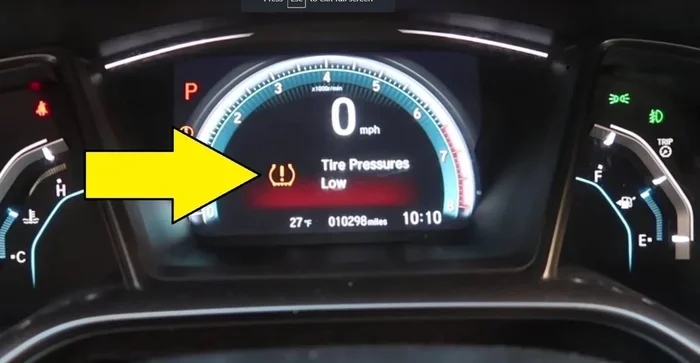
The TPMS warning light on your dashboard looks like a horseshoe shape with an exclamation point in the center. It illuminates when one or more tires are underinflated. Sometimes it flashes first and then stays solid, which can indicate a sensor malfunction rather than a pressure issue.
Why Does the TPMS Light Stay On After You Inflate Your Tires?
Even after you inflate your tires to the correct PSI, the TPMS light may not turn off immediately. This is normal. The system needs to detect the corrected pressure over time. In most cases, driving the car at a steady speed for a few miles will cause the light to reset. If it does not, you may need to manually reset the tire pressure monitoring system through your dashboard settings or by holding the TPMS reset button under the steering column.
When to Replace TPMS Sensors
TPMS sensors have batteries that typically last about five to seven years. If your TPMS light flashes intermittently or stays on even after you have confirmed all tires are at the correct pressure, a sensor battery may be dead. In this case, you will need to replace the sensor. A Honda dealer or qualified tire shop can handle this for you.
Common Tire Pressure Mistakes to Avoid
Even experienced drivers make mistakes when checking tire pressure. Here are some common errors to watch out for.
Checking Tires After Driving
This is the number one mistake. Checking your tires right after a drive gives you a falsely high reading because the air inside is warm. Always wait for the tires to cool down before measuring. This single habit change will dramatically improve the accuracy of your readings.
Relying on Gas Station Gauges
The pressure gauges at gas station air pumps are often worn out and inaccurate. They can read off by several PSI. Instead, use your own personal tire pressure gauge for checking, and only use the gas station pump for adding air.
Ignoring the Spare Tire
It is easy to forget about the spare tire, but it is there for a reason. A flat spare tire defeats the purpose of having one. Check its pressure at least twice a year to make sure it is ready when you need it.
Overinflating to the Max PSI on the Tire Sidewall
The number printed on the tire sidewall is the maximum pressure the tire can handle, not the recommended pressure for your car. Overinflating to the max PSI creates a harsh ride, reduces traction, and causes uneven wear. Always use the door jamb sticker number for your 2019 Honda Civic.
Neglecting Seasonal Pressure Changes
Air pressure inside tires decreases as temperatures drop. In winter, you may notice your TPMS light coming on more frequently. Check your pressure more often during seasonal transitions to stay safe and maintain optimal fuel economy.
Benefits of Regular Tire Pressure Checks
Making tire pressure checks a regular habit brings several real benefits to your daily driving.
First, properly inflated tires improve your fuel economy. Studies show that underinflated tires can reduce gas mileage by up to 3 percent. Over a year of driving, that adds up to real money saved at the pump.
Second, correct tire pressure extends the life of your tires. Even wear across the tread means you get more miles out of each set. Replacing tires is expensive, so anything you can do to maximize their lifespan is a smart move.
Third, proper inflation enhances safety. Well-inflated tires grip the road better in rain, snow, and dry conditions. They respond more predictably during emergency maneuvers. For a car like the 2019 Honda Civic, which many people use for daily commuting and weekend trips, this safety benefit cannot be overstated.
Finally, regular checks help you catch slow leaks early. A slow puncture from a nail or screw can drain your tire over days or weeks. Catching it early saves you from a roadside flat and prevents damage to the tire sidewall.
Quick Tips for Perfect Tire Pressure Maintenance
- Keep a tire gauge in your glove box. Do not rely on borrowing one from a gas station.
- Check all four tires at the same time. This gives you a complete picture of your car’s tire health.
- Set a monthly reminder on your phone. Consistency is the key to good tire maintenance.
- Invest in a portable air compressor. Having one in your trunk means you can handle low pressure anywhere.
- Record your readings. Write down the PSI each time you check. Tracking trends helps you spot slow leaks before they become big problems.
- Rotate your tires regularly. Rotation promotes even wear and works hand in hand with proper pressure.
Conclusion
Checking your tire pressure on a 2019 Honda Civic is one of the simplest and most impactful things you can do as a car owner. It takes just a few minutes, requires minimal tools, and pays off in safety, fuel savings, and longer tire life. Now that you know where to find the recommended PSI, how to use a tire gauge, and how to interpret your TPMS light, you are fully equipped to handle this task on your own.
Make it a habit. Check your tire pressure monthly, keep your gauge handy, and never ignore warning lights on your dashboard. Your 2019 Honda Civic will reward you with a smoother, safer, and more efficient ride every time you get behind the wheel.
Take five minutes today. Grab your gauge, step outside, and give your tires a quick check. Your future self and your wallet will both thank you.
Frequently Asked Questions
What is the recommended tire pressure for a 2019 Honda Civic?
For most 2019 Honda Civic models, the recommended tire pressure is 32 PSI for all four tires. However, you should always verify this number by checking the tire pressure placard on the driver-side door jamb or consulting your owner manual. The correct PSI may vary slightly depending on your trim level and tire size.
How do I reset the tire pressure light on a 2019 Honda Civic?
To reset the TPMS light on your 2019 Honda Civic, first make sure all tires are at the correct pressure. Then, with the engine running, locate the TPMS reset button beneath the steering column. Press and hold the button until the TPMS light blinks twice. Drive the car at a steady speed for a few miles, and the light should turn off automatically.
Can I check my tire pressure with the TPMS light off?
Yes, you can and should check your tire pressure even if the TPMS light is not on. The TPMS only activates when pressure drops significantly below the recommended level. Regular manual checks with a tire gauge catch slow leaks and minor pressure changes before they trigger the warning light.
How accurate are gas station tire pressure gauges?
Gas station tire pressure gauges are often inaccurate due to wear and lack of maintenance. They can read off by several PSI. For the most reliable results, use your own digital or dial tire gauge to check pressure, and only use the gas station pump to add air if needed.
What happens if I drive on underinflated tires?
Driving on underinflated tires increases rolling resistance, which reduces fuel economy and causes the tires to overheat. Over time, underinflation leads to premature and uneven wear on the outer edges of the tire tread. In severe cases, it can cause blowouts or loss of vehicle control, especially at highway speeds.
Should I check my tire pressure in cold weather?
Yes, cold weather causes tire pressure to drop. For every 10-degree Fahrenheit decrease in temperature, tire pressure can decrease by approximately 1 PSI. During winter months, check your tire pressure more frequently and make sure your 2019 Honda Civic tires remain at the recommended PSI for safe driving and optimal performance.