Where Can I Find the Year of My Forklift Right Here
Finding the year of your forklift is easier than you think, and it starts with knowing where to look. The data plate, serial number, and manufacturer records all hold the key to unlocking your lift truck’s manufacturing year. This guide walks you through every method step by step so you can identify your forklift year in minutes.
Have you ever stood in front of your forklift and thought, “I have no idea how old this thing is”? You are not alone. Many warehouse managers, equipment operators, and business owners face this exact problem every single day. Knowing where to find the year of your forklift matters more than most people realize. It affects maintenance schedules, parts compatibility, resale value, and even safety compliance.
The good news is that finding your forklift year is not some secret code only manufacturers know. It is right there on your machine, waiting to be discovered. Whether you have a brand-new lift truck or one that has been working hard for years, this guide will show you exactly how to find the information you need. We will cover every method, every location, and every trick that makes the process simple and fast.
Key Takeaways
- Check the data plate: The data plate is the most reliable source for finding your forklift year, and it is usually located in a visible spot on the machine.
- Know your serial number: Every forklift has a unique serial number that encodes the manufacturing year and production details.
- Brand-specific locations matter: Different forklift brands hide their identification tags in different spots, so knowing your brand helps.
- Use online lookup tools: Many manufacturers and third-party sites offer free forklift year lookup tools using your serial number.
- Alternative methods work too: Tire wear, engine type, and maintenance records can also help you estimate the forklift age.
- Keep records handy: Storing your forklift identification details in one place saves time and prevents future headaches.
📑 Table of Contents
Why Knowing Your Forklift Year Matters
You might wonder why the year of your forklift even matters. Can you not just run it and fix it when something breaks? Well, yes and no. The year tells you a lot about what your machine needs and how it fits into your daily operations.
First, forklift parts compatibility depends heavily on the model year. Parts designed for one generation of a forklift may not fit another. Ordering the wrong part wastes time and money. Second, safety standards change over time. Older forklifts may not meet current forklift safety inspection requirements. Third, resale value shifts based on age. If you plan to upgrade, knowing your forklift year helps set a fair price.
Maintenance schedules also depend on the year. Newer models have different service intervals than older ones. Your owner’s manual uses the year to tell you exactly what to do and when. Without the year, you are guessing, and guessing with heavy equipment is never a good idea.
How the Forklift Year Affects Daily Operations
Let us talk about real-world impact. Imagine you need a specific hydraulic pump for your lift truck. The part number changes between model years. If you do not know the year, you might order the wrong pump. Now your forklift sits idle, and your warehouse operations slow down.
Insurance and registration also play a role. Many regions require forklift registration based on the manufacturing year. Older machines may need additional inspections or certifications. Staying on top of your forklift year keeps you compliant and avoids costly fines or downtime.
The Data Plate: Your Forklift’s ID Card
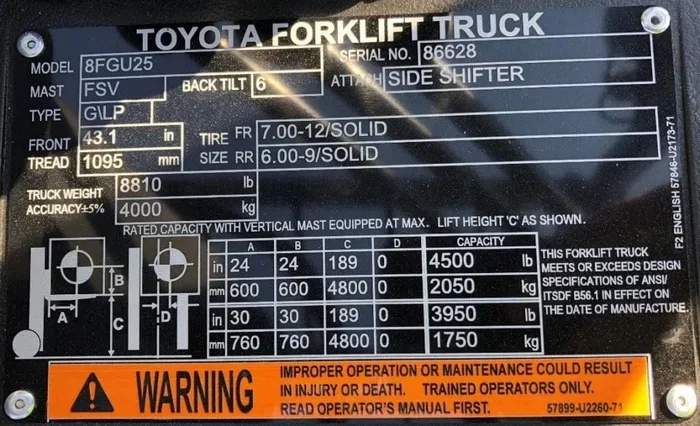
The forklift data plate is the single most important source for finding your machine’s year. Every forklift comes with one. It is a metal or stamped tag attached to the body of the truck. The data plate contains vital information, including the model number, serial number, lift capacity, and manufacturing date.
Think of the data plate as your forklift’s birth certificate. It tells the world exactly what your machine is, who made it, and when it rolled off the assembly line. Without it, identifying your forklift becomes much harder.
Where to Find the Data Plate
The data plate location varies by forklift type and brand. However, most manufacturers follow common placement patterns. Here are the most typical spots to check:
- On the carriage: Many forklifts have the data plate mounted on the carriage assembly, right behind the forks.
- Under the operator’s compartment: Look inside the cab or under the overhead guard. The plate is often bolted to a visible surface.
- On the mast: Some models place the tag on the mast channel or near the mast base.
- Near the battery compartment: Electric forklifts often have the data plate near the battery access area.
- On the frame: Check the main frame rail, especially on the side closest to the operator.
If you have trouble finding it, grab your forklift owner’s manual. The manual usually includes a diagram showing the exact data plate location for your specific model. This is one of the best reasons to keep that manual handy.
What Information Is on the Data Plate
The data plate contains several key fields. Let us break them down so you know exactly what to look for:
- Manufacturer name: Tells you who built the forklift, such as Toyota, Crown, Hyster, Yale, or CAT.
- Model number: Identifies the specific forklift model and configuration.
- Serial number: A unique code that encodes the manufacturing year and production sequence.
- Lift capacity: The maximum weight the forklift can safely carry.
- Load center: The distance from the fork face to the center of the load.
- Manufacturing date: Some data plates include a direct date stamp.
Not all data plates include a clear manufacturing date. That is where the serial number becomes your best friend. The serial number often contains a code that reveals the year directly.
Serial Number Locations by Forklift Brand
Every forklift brand has its own way of organizing serial numbers. The serial number is your shortcut to the year. Different brands place their serial numbers in different locations, so knowing your brand matters a lot.
Toyota Forklift Serial Number Location
Toyota forklifts are some of the most common in warehouses worldwide. On Toyota forklifts, the serial number is typically found on the data plate itself. The serial number format often includes a letter or number code at the beginning that represents the year of manufacture. For example, a serial number starting with certain letters corresponds to specific production years.
Crown Forklift Serial Number Location
Crown forklifts place their serial numbers on the data plate as well. Crown uses a coding system within the serial number that identifies the year and month of production. You can use Crown’s online serial number lookup tool to decode this information quickly.
Hyster Forklift Serial Number Location
Hyster forklifts often stamp the serial number directly onto the frame or chassis. The data plate on Hyster trucks also lists the serial number, but the physical stamp provides a backup. Hyster serial numbers follow a pattern where the first few digits indicate the year.
Yale Forklift Serial Number Location
Yale forklifts typically display the serial number on the data plate mounted on the carriage. Yale’s coding system embeds the year within the serial number sequence. Checking Yale’s official resources or contacting their support team can help you decode the year from the serial.
CAT and Other Major Brands
CAT forklifts, along with brands like Komatsu, Linde, and JCB, follow similar patterns. The serial number is always present on the data plate and often stamped on the frame. Each brand has its own coding logic for the year, but the principle remains the same: the serial number holds the answer.
| Brand | Data Plate Location | Serial Number Location | Year Coding Method |
|---|---|---|---|
| Toyota | Carriage or overhead guard | Data plate | First character(s) of serial |
| Crown | Operator compartment | Data plate | Encoded in serial digits |
| Hyster | Carriage or mast | Data plate and frame stamp | First digits of serial |
| Yale | Carriage | Data plate | Serial number sequence |
| CAT | Frame or data plate | Data plate and frame stamp | Year prefix in serial |
Alternative Methods to Determine Forklift Year
What if you cannot find the data plate or the serial number is worn off? Do not panic. There are several alternative methods to estimate or confirm your forklift year. These methods work especially well when the standard identification tags are missing or damaged.
Check the Tire Wear and Condition
Forklift tires wear down over time, and the pattern of wear can give you clues about the age of the machine. Original tires on a forklift typically last between 3,000 and 5,000 hours of operation. If the tires look brand new on an older-looking truck, someone may have replaced them. However, heavily worn tires on a machine with low hours suggest the forklift has been around for a while.
Tire type also helps narrow things down. Pneumatic tires, cushion tires, and polyurethane tires each became standard in different eras. Checking the tire type against production timelines gives you a rough estimate of the forklift year.
Examine the Engine or Motor Type
The type of engine or motor tells a story about when your forklift was made. Internal combustion engines were standard for decades. Electric motors became more advanced and common as environmental regulations tightened. Hybrid and fuel-cell forklifts are relatively new innovations.
If your forklift has a very old engine design, it was likely manufactured before a certain cutoff year. Conversely, if it has the latest electric motor technology, it is probably a recent model. This method gives you a general range rather than an exact year, but it is still useful.
Review Maintenance and Service Records
If you inherited the forklift from a previous owner, maintenance records are a goldmine. Service logs often include the date of purchase, the year of the machine, and the dates of major repairs or overhauls. These records can confirm the forklift year with high accuracy.
Even if you do not have formal records, check for any stickers or tags left by service technicians. Many technicians write the date of service directly on the forklift frame or data plate. These dates give you a reference point for estimating the manufacturing year.
Use Online Serial Number Lookup Tools
Many forklift manufacturers offer free online tools where you enter the serial number and receive detailed information, including the year. Toyota, Crown, Hyster, Yale, and others maintain databases specifically for this purpose.
Third-party websites also provide forklift year lookup services. These tools cross-reference serial number patterns against manufacturer databases. They are fast, easy to use, and often free. Just enter your serial number and wait for the results.
Contact the Manufacturer Directly
When all else fails, contact the manufacturer directly. Provide them with the serial number, model number, and any other identifying details. Most manufacturers have customer support teams trained to decode forklift identification numbers. They can tell you the exact year, month, and even the production plant where your forklift was built.
This method works best for well-known brands. Smaller or regional manufacturers may have less accessible databases, but they still maintain records of every unit they produced.
Common Mistakes When Looking Up Forklift Year
Even with a clear guide, people make mistakes when trying to find their forklift year. Avoiding these common errors saves you time, frustration, and money.
Relying Only on the Exterior Appearance
A forklift can look old or new depending on how well it has been maintained. A well-cared-for 15-year-old forklift might look newer than a neglected 5-year-old one. Never judge the forklift age by its appearance alone. Always check the data plate or serial number for the definitive answer.
Confusing the Model Number with the Serial Number
The model number tells you what type of forklift it is. The serial number tells you which specific unit it is, including the year. These are two completely different codes. Mixing them up leads to incorrect year lookups and wrong parts orders.
Ignoring the Data Plate Entirely
Some operators skip the data plate and go straight to online searches. This is a mistake. The data plate contains the most accurate and complete information about your forklift. Start there every time before trying alternative methods.
Not Checking for Multiple Data Plates
Some forklifts have more than one data plate. For example, there may be a plate on the carriage and another on the frame. These plates should contain matching information. If they do not, one of them may have been replaced, which could indicate a rebuild or major repair.
Forgetting to Verify the Year with the Brand’s Database
Even if you decode the serial number yourself, always double-check with the manufacturer’s official database. Different production runs can change the coding rules. Verification ensures you have the correct forklift year before making important decisions about parts, maintenance, or resale.
Tips for Keeping Track of Your Forklift Information
Once you find your forklift year, do not let that information disappear. Keeping organized records makes life easier every single day. Here are some practical tips to help you stay on top of your forklift data.
- Create a digital file: Take a photo of the data plate and save it in a cloud folder. You can access it from anywhere, anytime.
- Keep a maintenance log: Record every service, repair, and inspection with the date and the forklift year. This builds a complete history.
- Store the owner’s manual digitally: Scan the manual and save it alongside your data plate photo.
- Label the forklift: Add a small tag near the operator’s area with the year, model, and serial number. This makes future lookups instant.
- Set calendar reminders: Use the forklift year to schedule maintenance at the correct intervals. Set reminders for annual inspections and major service milestones.
These small habits pay off big time. When it is time to sell, upgrade, or troubleshoot, you will have all the information at your fingertips. No scrambling, no guessing, no delays.
Quick Tips for Finding Your Forklift Year Fast
- Always start with the data plate. It is the fastest and most accurate method.
- Have your owner’s manual nearby when you search for the data plate.
- Take a photo of the serial number in good lighting for easy reference.
- Use the manufacturer’s website serial number lookup tool for instant results.
- Contact the manufacturer’s support team if the serial number is unclear or damaged.
- Keep a backup record of the forklift year in your equipment management system.
Conclusion
Finding the year of your forklift does not have to be a mystery. The data plate and serial number are your two best tools, and they are right there on your machine. Whether you drive a Toyota, Crown, Hyster, Yale, or CAT forklift, the methods in this guide will help you uncover the manufacturing year quickly and accurately.
Use the alternative methods when the standard approach does not work. Check tire wear, engine type, and service records for additional clues. Avoid common mistakes like judging by appearance or confusing model numbers with serial numbers. And once you find the year, keep that information safe and organized for future reference.
Where Can I Find the Year of My Forklift is a question with a straightforward answer. The information is on your forklift, in your records, and available through your manufacturer. You now have every tool you need to find it fast. Go ahead, check your data plate, and put this knowledge to work today.
Frequently Asked Questions
What is a forklift data plate and where is it located?
The data plate is a metal tag attached to your forklift that contains vital information including the model number, serial number, and manufacturing date. You can usually find it on the carriage, under the operator’s compartment, on the mast, or near the battery compartment depending on your forklift brand and type.
Can I find the forklift year from the serial number alone?
Yes, in most cases the serial number encodes the manufacturing year within its sequence. Each forklift brand uses a slightly different coding system, so you may need to check the manufacturer’s website or contact their support team to decode the year accurately from the serial number.
What should I do if the data plate is missing or unreadable?
If the data plate is missing or damaged, you can try alternative methods such as checking the frame for a stamped serial number, reviewing maintenance records, examining tire wear patterns, or contacting the manufacturer directly with any other identifying information you have about the forklift.
Does the forklift year affect parts compatibility?
Absolutely. Different model years may use different components, so knowing the exact year ensures you order the correct parts. Using parts designed for a different year can lead to fitment issues, safety problems, and unnecessary expenses.
How can I verify the forklift year I found online?
The best way to verify is to cross-check with the manufacturer’s official serial number lookup tool or contact their customer support team directly. They can confirm the exact year based on your forklift’s unique serial number and model information.
Why is knowing my forklift year important for safety?
Forklift safety standards evolve over time, and older machines may not meet current inspection or certification requirements. Knowing the year helps you determine if your forklift needs additional safety checks, updates, or if it is time to consider replacing it with a newer, safer model.