Does Audi Show Tire Pressure on Your Vehicle Dashboard
Yes, most modern Audi vehicles display tire pressure information directly on the dashboard or through the instrument cluster. Your Audi uses a Tire Pressure Monitoring System (TPMS) to alert you when tire pressure drops below safe levels. Understanding how to read and reset these readings can save you from costly repairs and keep you safe on the road. Let us walk you through everything you need to know about your Audi’s tire pressure display.
Have you ever slid behind the wheel of your Audi and wondered, does Audi show tire pressure? It is a great question, and one that many Audi owners ask. The short answer is yes. Most modern Audi vehicles provide tire pressure information right on your dashboard or through the digital instrument cluster. But the full story is a bit more detailed, and knowing how your Audi handles tire pressure readings can make a big difference in your daily driving experience.
Your Audi is packed with smart technology designed to keep you safe and informed. The Tire Pressure Monitoring System, commonly known as TPMS, is one of the most important safety features on your vehicle. It constantly checks the air pressure inside your tires and lets you know when something is off. Whether you drive an Audi A4, an Audi Q5, or another model in the lineup, understanding your tire pressure display is essential. In this article, we will break down exactly how your Audi shows tire pressure, what the different warnings mean, and how you can stay on top of your tire health.
Key Takeaways
- Audi dashboards do show tire pressure: Most newer Audi models display tire pressure data on the digital instrument cluster or MMI screen.
- TPMS warning light is your first alert: A yellow horseshoe-shaped light with an exclamation mark appears when pressure drops significantly.
- You can reset tire pressure readings: The reset process is simple and varies slightly by model year.
- Recommended pressure varies by model: Check your owner’s manual or the door jamb sticker for the correct PSI.
- Low tire pressure affects safety and fuel economy: Driving on underinflated tires increases wear and reduces efficiency.
- Direct and indirect TPMS exist: Audi uses both types depending on the model and year.
- Regular checks still matter: Even with a dashboard display, manual checks with a gauge are smart practice.
📑 Table of Contents
- How Does Audi Show Tire Pressure on the Dashboard?
- What Is the Recommended Tire Pressure for Audi Vehicles?
- Types of Tire Pressure Monitoring Systems in Audi
- How to Reset Your Audi Tire Pressure Warning
- Common Tire Pressure Problems in Audi Vehicles
- How Often Should You Check Your Audi Tire Pressure?
- Expert Insights on Audi Tire Pressure Monitoring
- Key Takeaways
- Conclusion
How Does Audi Show Tire Pressure on the Dashboard?
Audi vehicles use a combination of dashboard lights, digital displays, and instrument cluster readings to communicate tire pressure information. The way your specific Audi shows this data depends on your model year and the trim level you own. Newer models from around 2015 onward tend to have more advanced digital displays that show real-time tire pressure readings. Older models may rely more on warning lights alone.
The TPMS Warning Light
The most common way your Audi alerts you to a tire pressure issue is through the TPMS warning light. This light looks like a horseshoe shape with an exclamation mark in the center. It is yellow and usually appears on the dashboard when one or more tires drop below the recommended pressure. When you see this light, it means your Audi has detected a significant pressure loss. You should check your tires as soon as it is safe to do so.
Here is what the TPMS light typically means:
- Steady yellow light: One or more tires are underinflated. Check your tire pressure right away.
- Flashing yellow light: There may be a malfunction with the TPMS system itself. Visit a service center for diagnosis.
- Light goes off after driving: The pressure may have been low but corrected itself, or the system reset.
Digital Instrument Cluster Readings
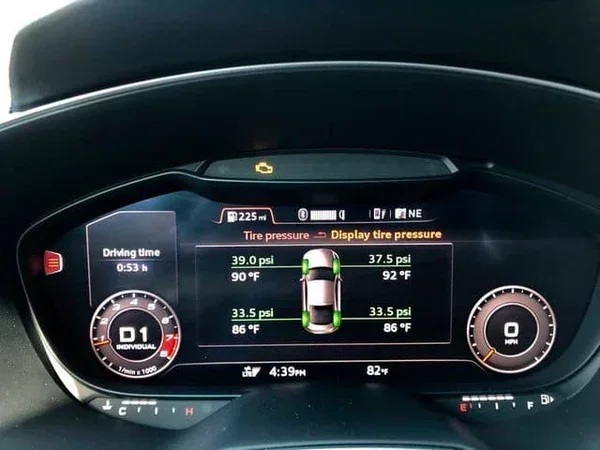
Many newer Audi models go beyond just a warning light. They actually display the specific tire pressure readings for each tire on the digital instrument cluster. This means you can see the exact PSI (pounds per square inch) for each tire at a glance. You can usually access this information through the steering wheel controls or the MMI (Multi Media Interface) system.
To view your tire pressure on the instrument cluster, try these steps:
- Press the button on the steering wheel that cycles through the display menu.
- Navigate to the vehicle status or tire pressure section.
- Look for individual tire readings listed by position (front left, front right, rear left, rear right).
- Compare the readings to the recommended pressure listed on your door jamb sticker.
Not all Audi models show this level of detail, though. Some only display the warning light. If you are unsure what your specific model shows, check your owner’s manual or ask your local Audi dealer.
What Is the Recommended Tire Pressure for Audi Vehicles?
Every Audi model has a specific recommended tire pressure. This number is not the same across all vehicles. The right pressure depends on your model, engine type, and tire size. Driving with the wrong pressure can lead to uneven tire wear, reduced fuel efficiency, and even dangerous blowouts.
Where to Find Your Recommended Pressure
You can find the recommended tire pressure for your Audi in a few easy places:
- Driver’s side door jamb: Open your driver’s door and look for a sticker on the door frame. It lists the correct PSI for both front and rear tires.
- Owner’s manual: Your Audi manual has a dedicated section on tire pressure specifications.
- Audi dealer: Your local Audi service center can confirm the correct pressure for your exact model.
As a general guideline, most Audi passenger vehicles recommend tire pressures between 30 and 35 PSI. However, SUVs like the Audi Q7 or Audi Q5 may require slightly higher pressures, especially when fully loaded. Always refer to your specific vehicle’s guidelines.
Why Proper Tire Pressure Matters
Keeping your tires at the correct pressure is about more than just avoiding a dashboard warning light. Here is why it matters:
- Safety: Underinflated tires can overheat and fail, especially at highway speeds. Overinflated tires have less grip on wet roads.
- Fuel economy: Tires with low rolling resistance from proper inflation help your Audi get better gas mileage.
- Tire longevity: Correct pressure prevents uneven wear patterns that shorten the life of your tires.
- Handling: Properly inflated tires give you better control and a smoother ride.
Types of Tire Pressure Monitoring Systems in Audi
Audi uses two main types of tire pressure monitoring systems. Understanding the difference helps you know what to expect from your dashboard display.
Direct TPMS
Direct TPMS uses small sensors inside each tire, usually mounted on the valve stem. These sensors measure the actual air pressure and send the data wirelessly to your vehicle’s computer. Most newer Audi models use direct TPMS because it provides accurate, real-time readings for each individual tire. When a sensor detects pressure that is 25% or more below the recommended level, it triggers the dashboard warning.
Direct TPMS sensors have a battery life of about 5 to 10 years. When the battery dies, the sensor needs to be replaced. You may see a TPMS malfunction light if a sensor battery has died.
Indirect TPMS
Indirect TPMS does not use physical sensors inside the tires. Instead, it uses the vehicle’s anti-lock braking system (ABS) sensors to monitor how fast each tire is spinning. A tire with low pressure has a smaller rolling radius, which causes it to spin faster than a properly inflated tire. The system detects this difference and triggers the warning light.
Indirect TPMS is less precise than direct TPMS. It also requires a reset procedure after you inflate your tires or rotate them. Some older Audi models and certain base trim levels use this system.
Comparison: Direct vs. Indirect TPMS
| Feature | Direct TPMS | Indirect TPMS |
|---|---|---|
| Accuracy | High | Moderate |
| Real-time readings | Yes | No |
| Sensor location | Inside tire (valve stem) | Uses ABS sensors |
| Reset required after inflation | Usually no | Yes |
| Cost to maintain | Higher (sensor replacement) | Lower |
| Used in Audi models | Most newer models | Older and base models |
How to Reset Your Audi Tire Pressure Warning
Sometimes after you check and inflate your tires, the TPMS warning light stays on. This is normal and simply means the system needs to be reset. Resetting the tire pressure light is a straightforward process, though the exact steps vary by Audi model and year.
Reset Steps for Most Audi Models
- Make sure all your tires are inflated to the recommended pressure.
- Start the engine and let the car idle for a few minutes.
- Use the steering wheel buttons to navigate to the vehicle settings menu on the instrument cluster.
- Find the tire pressure or service menu option.
- Select the option to reset or calibrate the TPMS system.
- Confirm the reset and drive the vehicle for a few miles. The light should turn off.
If the light does not turn off after resetting, there may be a slow leak in one of your tires or a faulty sensor. In that case, it is best to visit an Audi service center for a professional diagnosis. A technician can run a TPMS diagnostic scan and check each sensor individually.
Quick Tips for TPMS Reset
- Always check tire pressure when the tires are cold (before driving) for the most accurate reading.
- Keep your owner’s manual handy. It has model-specific reset instructions.
- If you replace tires or rotate them, you may need to reset the system.
- A TPMS reset tool from an auto parts store can also help if the dashboard method does not work.
Common Tire Pressure Problems in Audi Vehicles
Even with a reliable TPMS, Audi owners can run into tire pressure issues. Knowing the common problems helps you catch them early and avoid bigger headaches.
Slow Leaks
A slow leak is one of the most common reasons for low tire pressure. It can happen from a small nail or screw in the tread, a damaged valve stem, or even a poor seal between the tire and rim. Slow leaks are tricky because the pressure drops gradually, and you may not notice until the TPMS light comes on. If your Audi shows tire pressure dropping over a few days, inspect each tire carefully for punctures or damage.
Temperature Changes
Did you know that cold weather can cause your tire pressure to drop? Air inside tires contracts when temperatures fall, which reduces the pressure. This is why many drivers notice the TPMS light comes on more often in winter. A 10-degree drop in temperature can reduce tire pressure by about 1 PSI. During colder months, check your tire pressure more frequently and keep a portable tire inflator in your trunk.
TPMS Sensor Failure
TPMS sensors can fail over time, especially as they age. Battery death is the most common cause of sensor failure. When a sensor stops working, it cannot send pressure data to your vehicle’s computer. You may see a flashing TPMS light or a message on your MMI display indicating a sensor fault. Replacing a TPMS sensor is a relatively affordable repair, and it keeps your safety systems working properly.
Overinflation
People sometimes focus only on underinflation, but overinflation is also a problem. Overinflated tires have a smaller contact patch with the road, which reduces traction and causes uneven wear in the center of the tread. If your Audi shows tire pressure readings that are consistently above the recommended range, let some air out until you reach the correct PSI.
How Often Should You Check Your Audi Tire Pressure?
Even though your Audi has a TPMS that monitors pressure for you, it is still a good idea to check your tires manually on a regular basis. The TPMS only alerts you when pressure drops significantly, usually by 25% or more. By that point, your tires may already be compromised.
Here is a simple schedule to follow:
- Monthly: Check all four tires with a reliable tire pressure gauge.
- Before long trips: Verify pressure for all tires, including the spare.
- Seasonal changes: Check more frequently during temperature swings in fall and spring.
- After tire service: Re-check pressure after rotations, replacements, or repairs.
Keeping a quality digital tire gauge in your glove box makes this easy. Analog gauges work too, but digital ones tend to be more accurate and easier to read. A quick check takes less than five minutes and can add months or even years to your tire life.
Expert Insights on Audi Tire Pressure Monitoring
Automotive experts agree that understanding your Audi’s tire pressure system is one of the simplest ways to improve vehicle safety and performance. According to tire safety organizations, proper tire inflation can reduce the risk of a blowout by up to 60%. It also improves braking distance, especially on wet surfaces.
Many Audi owners overlook their tire pressure until the warning light appears. By then, the tires may already be underinflated enough to cause damage. Making tire pressure checks part of your regular vehicle maintenance routine is a small habit that pays big dividends. Whether your Audi shows tire pressure on the dashboard or only uses a warning light, staying proactive about your tire health is always the right move.
One more thing worth noting: if you ever buy aftermarket tires or wheels, make sure the TPMS sensors are compatible. Some aftermarket tires do not come with sensors, and you may need to transfer your existing sensors or purchase new ones. Your Audi dealer or a trusted tire shop can help with this.
Key Takeaways
- Audi dashboards do show tire pressure: Most newer Audi models display tire pressure data on the digital instrument cluster or MMI screen.
- TPMS warning light is your first alert: A yellow horseshoe-shaped light with an exclamation mark appears when pressure drops significantly.
- You can reset tire pressure readings: The reset process is simple and varies slightly by model year.
- Recommended pressure varies by model: Check your owner’s manual or the door jamb sticker for the correct PSI.
- Low tire pressure affects safety and fuel economy: Driving on underinflated tires increases wear and reduces efficiency.
- Direct and indirect TPMS exist: Audi uses both types depending on the model and year.
- Regular checks still matter: Even with a dashboard display, manual checks with a gauge are smart practice.
Conclusion
So, does Audi show tire pressure? Yes, absolutely. Whether through a dashboard warning light, a digital instrument cluster display, or the MMI screen, your Audi gives you the tools to monitor your tire pressure effectively. Understanding how these systems work, what the different alerts mean, and how to respond to them puts you ahead of the curve when it comes to vehicle maintenance.
Taking care of your tires is one of the easiest and most impactful things you can do for your Audi. Proper tire pressure keeps you safe, saves fuel, and extends the life of your tires. Make it a habit to check your pressure regularly, pay attention to your dashboard alerts, and reset your TPMS system after any adjustments. Your Audi is designed to keep you informed, and now you know exactly how to use that information to your advantage.
Stay proactive about your tire health, and your Audi will reward you with a smoother, safer, and more efficient ride every time you hit the road.
Frequently Asked Questions
How do I check my tire pressure if my Audi does not have a digital display?
You can use a manual tire pressure gauge, which you can buy at any auto parts store for under $20. Remove the valve cap on each tire, press the gauge firmly onto the valve stem, and read the PSI. Compare it to the recommended pressure listed on your driver’s side door jamb.
Can I drive with the TPMS light on?
You should not drive with the TPMS light on for long distances. Low tire pressure can cause overheating, reduced handling, and even a blowout. Check your tire pressure as soon as possible and inflate to the recommended level. If the light stays on after inflating, reset the system or visit a service center.
How much does it cost to replace a TPMS sensor in an Audi?
The cost varies by model and whether you replace one sensor or all four. On average, expect to pay between $50 and $100 per sensor for parts, plus labor. Some Audi dealerships offer TPMS sensor replacement packages that include programming and calibration.
Why does my Audi tire pressure light come on in cold weather?
Cold air causes the air inside your tires to contract, which lowers the pressure. A drop of just a few PSI can be enough to trigger the TPMS light. This is normal and usually resolves once the tires warm up from driving or the temperatures rise. You can add a bit of air to bring the pressure back to the recommended level.
How often do Audi TPMS sensors need to be replaced?
TPMS sensors typically last between 5 and 10 years, depending on usage and driving conditions. The battery inside each sensor is not replaceable, so when it dies, the entire sensor needs to be replaced. If you notice a flashing TPMS light or a sensor fault message, it is time to have the sensors checked.
Is it safe to use aftermarket tires with my Audi’s TPMS system?
Yes, but you need to ensure compatibility. Aftermarket tires and wheels should work with your TPMS sensors, but you may need to transfer your existing sensors to the new tires or purchase new ones. Always consult with a qualified technician or your Audi dealer to make sure everything is set up correctly.