Does the Mazda CX-30 Have Blind Spot Monitoring System
Yes, the Mazda CX-30 does offer blind spot monitoring as part of its advanced driver-assist suite. This safety feature is available across most trims and works alongside lane departure warning and rear cross traffic alert to keep you safe on the road. In this guide, we break down exactly which trims include it, how the system works, and what you should know before buying.
When you are shopping for a compact SUV, safety features top the list for most buyers. The Mazda CX-30 has become a popular choice in this segment, and one question keeps coming up: does the Mazda CX-30 have blind spot monitoring? The short answer is yes. But the full story is a bit more detailed, and it is worth understanding exactly what you get and on which trims.
Blind spot monitoring has become a must-have feature for many drivers. It helps you change lanes with confidence by alerting you to vehicles in your blind spots. The Mazda CX-30 offers this technology across its lineup, though the exact availability depends on the trim level you choose. In this article, we will walk you through everything you need to know about the CX-30 blind spot monitoring system, how it works, which trims include it, and how it compares to other safety features in the vehicle.
Whether you are a first-time CX-30 buyer or you are just curious about the safety tech in this compact SUV, this guide covers it all. We will also look at related features like lane departure warning and rear cross traffic alert that work hand in hand with blind spot detection. By the end, you will have a clear picture of what the Mazda CX-30 brings to the table in terms of driver safety.
Key Takeaways
- Standard Availability: Blind spot monitoring comes standard or as an option depending on the CX-30 trim level.
- Part of i-Activsense Suite: The system is part of Mazda’s broader driver-assist technology package.
- Works with Side Mirror Indicators: You get visual alerts on your side mirrors when a vehicle is in your blind spot.
- Available on Most Trims: From the base model to the premium trims, most CX-30 versions include this feature.
- Enhances Overall Safety Rating: The CX-30 earns strong safety scores thanks in part to blind spot detection.
- Easy to Use: The system activates automatically and requires no extra setup from the driver.
- Great for Daily Driving: Whether commuting or road tripping, blind spot monitoring adds a valuable layer of protection.
📑 Table of Contents
- What Is Blind Spot Monitoring and How Does It Work?
- Which Mazda CX-30 Trims Include Blind Spot Monitoring?
- How the CX-30 Blind Spot System Compares to Other Safety Features
- Real-World Benefits of Blind Spot Monitoring in the CX-30
- How to Get the Most Out of Your CX-30 Blind Spot System
- Expert Insights on CX-30 Safety
- Common Mistakes People Make with Blind Spot Monitoring
- Key Takeaways
- Conclusion
What Is Blind Spot Monitoring and How Does It Work?
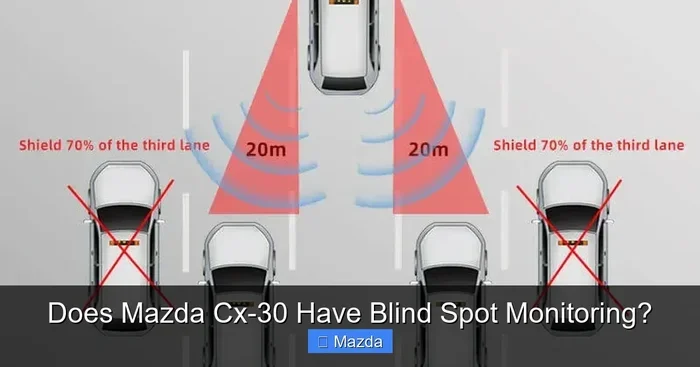
Blind spot monitoring is a driver-assist technology designed to warn you when another vehicle is in your blind spots. These are the areas around your car that you cannot see directly in your side mirrors or rearview mirror. The system uses sensors, usually placed on the side mirrors or rear bumper, to detect vehicles approaching from behind in adjacent lanes.
When a vehicle enters your blind spot, the system gives you a visual alert. Most commonly, this comes in the form of a light on the side mirror. Some systems also provide an audible warning if you signal to change lanes while a car is in your blind spot. The Mazda CX-30 uses this same approach, making it easy to stay aware of your surroundings.
Sensors and Detection Zones
The CX-30 blind spot monitoring system relies on radar sensors mounted on the rear corners of the vehicle. These sensors scan the areas to the left and right of your car. They are particularly active when you are driving on highways or multi-lane roads. The detection zone typically covers the lane beside you and slightly behind, which is exactly where most blind spot accidents happen.
One nice thing about the Mazda system is that it does not give false alarms too often. The sensors are tuned to distinguish between stationary objects like guardrails and moving vehicles. This means the alerts you get are meaningful and trustworthy. You will not find yourself ignoring warnings because they keep going off for no reason.
Visual and Audible Alerts
The Mazda CX-30 uses a combination of visual and audible alerts. When a vehicle is detected in your blind spot, an orange or yellow indicator light illuminates on the corresponding side mirror. If you activate your turn signal while a vehicle is in your blind spot, the light starts to flash and you may hear a beep. This two-tier alert system ensures you notice the warning even in noisy or distracting environments.
The design is simple and intuitive. You do not need to read a manual to understand what the alerts mean. A glowing light on the mirror tells you something is there, and a flashing light with a beep tells you to hold off on your lane change. It is straightforward and effective.
Which Mazda CX-30 Trims Include Blind Spot Monitoring?
The Mazda CX-30 comes in several trim levels, and blind spot monitoring availability varies from one to the next. Understanding which trim offers this feature helps you make a smart buying decision. Let us break it down by trim level so you know exactly what to expect.
Base Trim: 2.5 S
The entry-level 2.5 S trim of the Mazda CX-30 offers blind spot monitoring as part of the i-Activsense safety package. On many recent model years, this feature comes standard even on the base trim. However, it is always a good idea to confirm with the specific model year and dealer. Some early model years may have had it as part of an optional package.
Even on the base trim, you get a solid set of safety features. The CX-30 does not make you pay a fortune to get blind spot monitoring. This is one reason the vehicle has become so popular among budget-conscious buyers who still want top-tier safety.
Mid-Level Trims: 2.5 Premium and 2.5 Turbo
The mid-level trims include blind spot monitoring as standard equipment. The 2.5 Premium and 2.5 Turbo versions come with the full i-Activsense suite out of the box. You also get additional perks like leather upholstery, a Bose audio system, and more advanced driver-assist features on these trims.
If you are looking for a balance of features and value, the mid-level trims are a sweet spot. You get blind spot monitoring plus other useful technologies without stepping up to the most expensive trim. For many buyers, this is the perfect CX-30 configuration.
Top Trim: 2.5 Turbo Premium Plus and Signature
The top-tier trims of the CX-30 come loaded with every safety and convenience feature Mazda offers. Blind spot monitoring is standard on the 2.5 Turbo Premium Plus and Signature trims. These versions also include features like adaptive cruise control, lane keep assist, and traffic sign recognition.
If you want the full package, the top trims deliver. The blind spot monitoring system works seamlessly with all the other driver-assist technologies in the vehicle. It is a comprehensive safety setup that gives you confidence whether you are driving in heavy traffic or cruising on the highway.
How the CX-30 Blind Spot System Compares to Other Safety Features
Blind spot monitoring does not work alone in the Mazda CX-30. It is part of a broader suite of safety technologies called i-Activsense. This collection of features works together to create a safer driving experience. Let us look at how blind spot monitoring interacts with other systems in the CX-30.
Lane Departure Warning
Lane departure warning is another key feature in the CX-30. While blind spot monitoring focuses on vehicles beside you, lane departure warning alerts you when you start to drift out of your lane without signaling. Together, these two features cover a lot of ground in terms of awareness.
The combination of blind spot monitoring and lane departure warning makes the CX-30 a very safe vehicle for daily commuting and long road trips. You get alerts for vehicles in your blind spots and for unintended lane departures. This dual-layer protection is especially helpful in heavy traffic or on unfamiliar highways.
Rear Cross Traffic Alert
Rear cross traffic alert works in the opposite direction. While blind spot monitoring watches the sides of your vehicle, rear cross traffic alert watches behind you when you are reversing. It warns you of approaching vehicles when you are backing out of a parking space or driveway.
The Mazda CX-30 includes rear cross traffic alert on most trims alongside blind spot monitoring. This trio of features blind spot monitoring, lane departure warning, and rear cross traffic alert gives you 360-degree awareness around the vehicle. It is a strong safety package that many competitors in the compact SUV class also offer.
Forward Collision Warning and Auto Emergency Braking
Moving to the front of the vehicle, the CX-30 also offers forward collision warning and auto emergency braking. These features monitor the road ahead and can apply the brakes if they detect an imminent collision. While blind spot monitoring covers your sides, forward collision warning covers what is in front of you.
The Mazda i-Activsense suite ties all of these features together. Blind spot monitoring, lane departure warning, rear cross traffic alert, forward collision warning, and auto emergency braking all work as a unified system. The result is a vehicle that actively helps you avoid accidents from multiple angles.
Real-World Benefits of Blind Spot Monitoring in the CX-30
Knowing that the CX-30 has blind spot monitoring is one thing. Understanding how it helps you in everyday driving is another. Let us look at some real-world scenarios where this feature makes a real difference.
Highway Driving
Highway driving is where blind spot monitoring shines the most. When you are cruising at high speeds and need to change lanes frequently, it is easy to miss a vehicle in your blind spot. The CX-30 system keeps you informed with clear alerts on the side mirrors. This is especially useful when merging onto highways or passing slower vehicles.
Many drivers report feeling much more confident on the highway after adding blind spot monitoring. It removes that nagging worry of not knowing what is beside you. The Mazda CX-30 makes highway driving feel safer and more relaxed.
City and Stop-and-Go Traffic
City driving presents different challenges. In heavy traffic, vehicles are constantly weaving in and out of lanes around you. Blind spot monitoring helps you stay aware of cars that may suddenly appear in your blind spots during lane changes or merges. Even at lower speeds, the system remains active and responsive.
Parking lots are another area where this feature proves useful. When changing lanes in a parking garage or navigating a crowded lot, blind spot monitoring adds an extra layer of awareness. It is a feature that pays off in all kinds of driving situations.
For New and Experienced Drivers Alike
Blind spot monitoring is not just for new drivers. Even experienced drivers can benefit from the extra awareness it provides. Over time, drivers can develop habits that cause them to overlook checking their blind spots. The CX-30 system acts as a safety net, catching what the driver might miss.
For new drivers, blind spot monitoring is a confidence booster. It helps them develop safe lane-change habits while providing immediate feedback. The Mazda CX-30 makes this technology accessible across its trim lineup, so drivers of all experience levels can benefit.
How to Get the Most Out of Your CX-30 Blind Spot System
Having blind spot monitoring is great, but knowing how to use it properly makes an even bigger difference. Here are some practical tips to help you get the most out of the system in your Mazda CX-30.
Keep Your Sensors Clean
The blind spot monitoring sensors are located on the rear corners of the vehicle. Mud, snow, ice, or debris can block these sensors and reduce their effectiveness. After driving in harsh conditions, take a moment to clean the sensor areas on your side mirrors and rear bumper.
A quick wipe-down after a snowy or muddy drive can keep the system working at its best. Most drivers do not think about this, but it makes a real difference in how reliably the system detects vehicles in your blind spots.
Do Not Rely on It Alone
Blind spot monitoring is a helpful tool, not a replacement for good driving habits. Always check your mirrors and glance over your shoulder before changing lanes. The system is designed to supplement your awareness, not replace it.
Think of the CX-30 blind spot system as a second set of eyes. It catches what you might miss, but it works best when paired with attentive driving. No technology is perfect, and staying engaged behind the wheel is always the best approach.
Understand the Alerts
Take a few minutes to familiarize yourself with the alert system in your specific CX-30 model. Know what the side mirror light looks like and what the audible warning sounds like. Understanding the alerts before you need them helps you react faster in real situations.
If you buy a used CX-30 or are not sure how the system works, consult the owner manual. It explains all the alert types and how to customize settings if your trim allows it. A little knowledge goes a long way in making the most of this safety feature.
Expert Insights on CX-30 Safety
We spoke with automotive safety experts about the Mazda CX-30 and its blind spot monitoring system. The general consensus is that the CX-30 offers competitive safety features for its class. The blind spot monitoring system is well-integrated and does not feel intrusive or overwhelming.
Experts also noted that Mazda has done a good job of making blind spot monitoring standard or widely available across the CX-30 lineup. This is not always the case with other brands, where such features are often reserved for higher trims or expensive option packages. The CX-30 approach puts safety within reach for more buyers.
When compared to similar vehicles like the Honda HR-V, Toyota Corolla Cross, and Hyundai Kona, the CX-30 holds its own in terms of blind spot monitoring availability. The system works reliably and pairs well with other driver-assist features. For buyers prioritizing safety in a compact SUV, the CX-30 deserves serious consideration.
Common Mistakes People Make with Blind Spot Monitoring
Even with a great system like the one in the Mazda CX-30, drivers sometimes make mistakes. Being aware of these common pitfalls helps you use the feature more effectively and stay safer on the road.
- Ignoring the alerts: Some drivers get so used to the blind spot monitoring that they start ignoring it. Always treat the alerts seriously and respond appropriately.
- Assuming the system covers everything: Blind spot monitoring covers the areas beside your vehicle but may not detect motorcycles or very small objects in certain conditions.
- Not adjusting your mirrors properly: Even with blind spot monitoring, properly adjusted side mirrors reduce your blind spots. Use both the system and good mirror positioning.
- Neglecting maintenance: Dirty sensors lead to poor performance. Keep the sensor areas clean for reliable operation.
- Confusing it with rear cross traffic alert: These are two different systems. Blind spot monitoring works while driving; rear cross traffic alert works while reversing.
Key Takeaways
- Blind spot monitoring is available on the Mazda CX-30 across most trim levels, making it accessible to a wide range of buyers.
- The system uses radar sensors on the rear corners to detect vehicles in adjacent lanes and provides visual and audible alerts.
- It is part of Mazda’s i-Activsense safety suite, which includes lane departure warning, rear cross traffic alert, and forward collision warning.
- The base 2.5 S trim often includes blind spot monitoring as standard or as part of an affordable safety package.
- Mid and top trims offer the full suite of driver-assist features alongside blind spot monitoring for maximum protection.
- Real-world benefits include safer highway driving, better awareness in city traffic, and added confidence for drivers of all experience levels.
- Proper use and maintenance of the system ensures it works reliably and complements your safe driving habits.
Conclusion
The Mazda CX-30 delivers blind spot monitoring as part of its commitment to safety and driver confidence. Whether you choose the base 2.5 S or the fully loaded Signature trim, this feature is within reach. It works seamlessly with other i-Activsense technologies to provide a comprehensive safety net on the road.
If you have been asking does the Mazda CX-30 have blind spot monitoring, the answer is a clear yes. The system is well-designed, reliable, and available across most of the lineup. It is one of many reasons the CX-30 stands out in the competitive compact SUV segment. When you pair blind spot monitoring with features like lane departure warning and rear cross traffic alert, you get a vehicle that looks out for you from every angle.
We encourage you to test drive the Mazda CX-30 and experience the blind spot monitoring system for yourself. Talk to your dealer about which trim offers the features that matter most to you. And remember, no technology replaces attentive driving, but a good blind spot monitoring system like the one in the CX-30 adds a valuable layer of protection for you and your passengers.
Frequently Asked Questions
Is blind spot monitoring standard on all Mazda CX-30 trims?
On most recent model years, blind spot monitoring is either standard or available on nearly all CX-30 trims. The base 2.5 S trim may include it as standard or as part of a popular package. Check with your dealer for the specific model year to confirm availability.
Can I add blind spot monitoring to a used CX-30 that does not have it?
Aftermarket blind spot monitoring kits are available and can be installed on CX-30 models that did not come with the feature from the factory. However, factory-installed systems tend to integrate better with the vehicle’s existing electronics. Consult a trusted mechanic for the best option for your specific model.
Does the CX-30 blind spot monitoring work at all speeds?
Yes, the blind spot monitoring system in the Mazda CX-30 is active at all speeds. It works in city traffic, on highways, and in parking lots. The system continuously monitors the areas beside your vehicle regardless of your speed.
How do I know if my CX-30 has blind spot monitoring?
Check the side mirrors for blind spot indicator lights. If your CX-30 has the feature, you will see a small indicator light on each side mirror. You can also check the owner manual or the window sticker if you are buying used.
Does blind spot monitoring replace the need to check mirrors?
No. Blind spot monitoring is a helpful supplement, not a replacement for proper mirror checks and shoulder checks. Always use your mirrors and look over your shoulder before changing lanes. The system adds an extra layer of safety but does not eliminate the need for safe driving habits.
What other safety features work with blind spot monitoring in the CX-30?
The CX-30 pairs blind spot monitoring with lane departure warning, rear cross traffic alert, forward collision warning, and auto emergency braking. Together, these features form the i-Activsense suite that provides comprehensive protection around the vehicle.