How Big of a Camper Can a Toyota Tundra Pull Safely
The Toyota Tundra can pull a wide range of campers, but the exact size depends on your model year, engine, and configuration. Most Tundra models have a towing capacity between 8,000 and 12,000 pounds, which covers everything from small pop-up campers to large travel trailers. Understanding your truck’s limits and choosing the right camper size ensures safe, stress-free trips every time.
Planning a camping trip is one of the best ways to unwind and reconnect with nature. But before you hit the road, you need to know one critical thing: how big of a camper can a Toyota Tundra pull. The answer isn’t as simple as picking a number off a spec sheet. Your truck’s year, trim level, engine type, and even your payload all play a role in determining the right camper size for your Tundra.
Whether you’re a first-time towers or a seasoned RVer, this guide breaks down everything you need to know. We’ll walk through towing capacity numbers, camper types, safety tips, and common mistakes. By the end, you’ll feel confident choosing the perfect travel trailer or fifth wheel for your Toyota Tundra. Let’s get into it.
Key Takeaways
- Towing Capacity Matters: The Toyota Tundra pull capacity ranges from 8,000 to 12,000 lbs depending on the year and configuration.
- Camper Size Varies by Type: Travel trailers, fifth wheels, and pop-up campers all fall within different weight ranges that your Tundra can handle.
- Payload Is Just as Important: Your truck’s payload capacity affects how much weight you can safely carry in the bed and tongue weight combined.
- Engine and Drivetrain Make a Difference: The i-FORCE MAX twin-turbo engine offers the best towing performance for larger campers.
- Safety Equipment Is Essential: A weight distribution hitch, brake controller, and trailer sway control all contribute to safe towing.
- Know Your Truck’s Limits: Always check your owner’s manual and the door jamb sticker for exact towing and payload numbers.
📑 Table of Contents
Understanding Your Toyota Tundra Towing Capacity
The foundation of safe towing starts with knowing your truck’s limits. Every Toyota Tundra has a maximum towing capacity listed in the owner’s manual. But that number is just the starting point. Several factors can change what your specific truck can safely handle.
What Does Towing Capacity Mean?
Towing capacity is the maximum weight your truck can safely pull behind it. This number includes the weight of the trailer itself plus everything inside it. It’s measured by the manufacturer under specific conditions. For the Toyota Tundra, towing capacity has evolved over the years.
The latest 2024 Toyota Tundra with the i-FORCE MAX twin-turbo V6 engine can tow up to 12,000 pounds when properly equipped. Older models, like the 2007 through 2021 Tundra, typically maxed out around 10,200 to 10,500 pounds. Always verify your specific model’s rating because trim levels and drivetrain options change the numbers.
Why Payload Capacity Is Equally Important
Here’s something many towers overlook. Payload capacity is the maximum weight your truck can carry in the cab and bed combined. This includes passengers, gear, and the tongue weight of your trailer. Tongue weight is the downward force the trailer hitch puts on your truck’s receiver.
A common rule of thumb is that tongue weight should be about 10 to 15 percent of your trailer’s total weight. So if your camper weighs 6,000 pounds, your tongue weight could be between 600 and 900 pounds. Add that to the weight of your passengers and gear, and you might find your payload is maxed out before you even reach your towing limit.
Check the yellow sticker on your driver’s door jamb. It lists your truck’s GVWR (Gross Vehicle Weight Rating) and payload limits. This sticker is your best friend when planning a towing setup.
What Size Camper Can a Toyota Tundra Pull?
Now for the fun part. Let’s talk about actual camper sizes and what your Tundra can handle. The answer depends on the type of camper you’re considering.
Pop-Up Campers and Small Teardrops
Pop-up campers and teardrop trailers are the lightest options on the market. Most pop-ups weigh between 1,000 and 3,500 pounds. Teardrop trailers typically range from 1,000 to 2,500 pounds. Your Toyota Tundra can easily tow these with room to spare.
These small campers for Tundra are perfect for weekend getaways. They’re fuel-efficient, easy to maneuver, and don’t put much stress on your truck. Even older Tundra models handle these without any issues.
Travel Trailers
Travel trailers are the most common type of RV towing. They range widely in size and weight. Small travel trailers (20 to 25 feet) typically weigh between 3,500 and 6,000 pounds. Mid-size travel trailers (26 to 30 feet) can weigh 6,000 to 9,000 pounds. Large travel trailers (30 to 35 feet) may weigh 9,000 to 12,000 pounds.
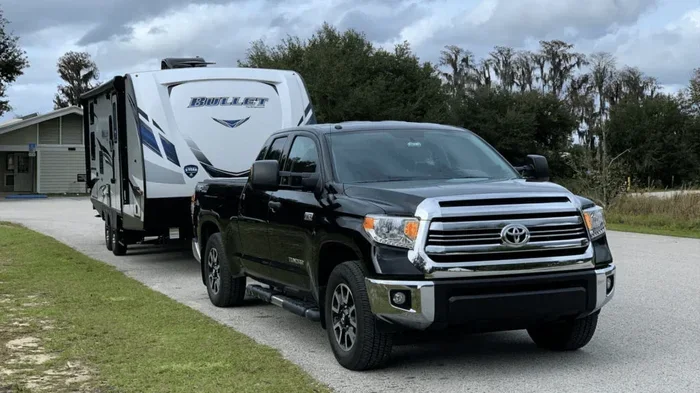
A Toyota Tundra can pull most travel trailers in the 20 to 30-foot range without breaking a sweat. If you have a newer 2024 model with the i-FORCE MAX engine, you can handle a larger travel trailer up to 35 feet. Just make sure your payload can support the hitch weight.
Fifth Wheel and Gooseneck Campers
Fifth wheel trailers sit over the bed of your truck and connect to a special hitch in the pickup box. They offer better stability and more interior space. Gooseneck trailers use a similar setup but with a ball hitch in the bed.
A Toyota Tundra can tow a fifth wheel or gooseneck setup, but there’s a catch. The truck bed takes on significant weight with these setups. Your payload capacity becomes the limiting factor more often than your towing capacity. A fifth wheel camper that weighs 10,000 to 12,000 pounds is possible for a properly equipped Tundra, but you’ll need to watch your payload carefully.
Toy Haulers and Bumper Pull Campers
Toy haulers are a popular choice for outdoor enthusiasts. They feature a garage area at the back for ATVs, bikes, or kayaks. These campers tend to be heavier because of the reinforced garage floor. A typical toy hauler weighs 6,000 to 10,000 pounds.
Bumper pull campers are another term for traditional travel trailers. They attach to a standard hitch receiver on the back of your Tundra. These are the most versatile and widely available camper options for Toyota Tundra owners.
Key Factors That Affect Towing Performance
Towing isn’t just about numbers on a spec sheet. Real-world performance depends on several factors that every Tundra owner should understand.
Engine and Transmission
The engine under your hood makes a big difference. The i-FORCE MAX twin-turbo V6 in the 2024 Tundra delivers strong torque at low RPMs, which is exactly what you want when pulling a heavy load. Torque is the twisting force that gets your rig moving from a stop and keeps it climbing hills.
The older 5.7-liter V8 in pre-2022 Tundras was also a reliable workhorse. It produced solid torque and handled medium-sized campers well. Whatever engine you have, keeping up with regular maintenance like transmission fluid changes helps your truck stay strong under load.
Drivetrain Considerations
Most Tundra models come with rear-wheel drive (RWD) or four-wheel drive (4WD). For towing, 4WD offers better traction on loose or wet surfaces. If you plan to camp on gravel roads or in muddy conditions, 4WD gives you an extra safety margin.
However, 4WD adds weight to the truck, which slightly reduces your available payload. Keep this trade-off in mind when configuring your towing setup.
Hitch and Weight Distribution
The right hitch setup can transform your towing experience. A weight distribution hitch uses spring bars to spread the trailer’s tongue weight across all four wheels of your truck. This improves stability and keeps your truck level.
For heavier campers, a weight distribution system with a sway control feature is highly recommended. Trailer sway can be dangerous, especially in crosswinds or when passing large trucks on the highway. A good sway control system helps keep your setup stable and predictable.
Brake Controllers and Electrical Setup
Your trailer needs its own braking system, and your Tundra needs a way to control it. A trailer brake controller is a small device installed under your dash that applies your trailer’s brakes in sync with your truck’s brakes.
Most modern Tundras come with a wiring harness pre-installed for trailer lights and brakes. If yours doesn’t, having a professional install a compatible harness is a smart investment. Proper lighting ensures other drivers can see your setup and communicate your intentions on the road.
Tips for Safe and Easy Towing
Towing a camper trailer is a skill that improves with practice. Here are some practical tips to make your towing experience safer and more enjoyable.
Do a Pre-Trip Safety Check
Before every trip, walk around your truck and trailer. Check that all lights work, tires are properly inflated, and connections are secure. Verify your tongue weight is within the recommended range. A quick five-minute check can prevent problems on the road.
Practice Driving with Your Trailer
If you’re new to towing, practice in an empty parking lot before hitting the highway. Get a feel for how your Tundra handles with the extra weight. Learn your turning radius, braking distance, and how your trailer responds to steering inputs.
Remember that stopping distance increases significantly with a trailer. Leave plenty of following distance and brake gently and early. Sudden stops can cause the trailer to sway or jackknife.
Manage Your Speed
Driving slower improves stability and fuel economy. Most experts recommend staying between 55 and 65 miles per hour when towing. Going too fast puts extra stress on your engine, transmission, and brakes. It also increases the risk of trailer sway.
Load Your Trailer Properly
How you load your camper matters more than you might think. Place heavier items over the axle and lighter items toward the front of the trailer. This keeps the tongue weight in the right range and prevents the trailer from fishtailing.
Secure all loose items inside the trailer. A shifting load during transit can change your weight distribution and affect handling. Use straps, bungee cords, and storage bins to keep everything in place.
Use the Right Tires
Your Tundra’s tires are the only contact point between your truck and the road. Make sure they’re rated for the weight you’re towing. Check tire pressure before every trip and inspect the tires for wear or damage.
If you frequently tow heavy loads, consider upgrading to tires with a higher load rating. This small change can make a big difference in safety and confidence on the road.
Install a Transmission Cooler
Towing puts extra heat on your transmission, especially in hot weather or when driving through mountains. An aftermarket transmission cooler helps maintain proper fluid temperatures and extends the life of your transmission.
This is especially important if you plan to tow near your truck’s maximum capacity on a regular basis. The extra investment pays off in reliability and peace of mind.
Common Towing Mistakes to Avoid
Even experienced towers can make mistakes. Here are the most common errors that compromise safety and performance.
Exceeding Towing or Payload Limits
This is the number one mistake. Just because your Tundra can technically tow 12,000 pounds doesn’t mean you should max it out every time. Exceeding limits strains your engine, transmission, and brakes. It also voids your warranty in many cases. Always stay well within your truck’s rated capacity.
Ignoring Tongue Weight
Too little tongue weight causes trailer sway. Too much tongue weight overloads your rear axle and makes steering feel heavy. Aim for the 10 to 15 percent range and use a tongue weight scale to verify before every trip.
Skipping the Brake Controller
Driving without a properly functioning brake controller is dangerous. Your trailer’s brakes need to work in harmony with your truck’s brakes. Without a brake controller, your stopping distance increases dramatically and your trailer can push your truck from behind during emergency stops.
Neglecting Maintenance
Towing is harder on your truck than driving solo. Change your oil more frequently, check your transmission fluid regularly, and inspect your brakes often. Skipping maintenance leads to expensive repairs and potential breakdowns on the road.
Underestimating Wind Effects
Wind is an often-overlooked factor in towing. A strong crosswind can push a large trailer sideways. High-profile trailers catch more wind and are more affected. Reduce your speed in windy conditions and consider a wind deflector or trailer fairing for improved aerodynamics.
Choosing the Right Camper for Your Toyota Tundra
With so many camper options on the market, how do you pick the right one? Start by knowing your truck’s exact towing and payload numbers. Then match those numbers to the camper’s dry weight (weight without gear and water).
Add the weight of everything you’ll bring: water, propane, food, clothes, and gear. This gives you the gross trailer weight (GTW), which is the number you compare against your Tundra’s towing capacity.
Popular camper brands that work well with the Tundra include Lance, Jayco, Forest River, and Grand Design. These manufacturers offer lightweight travel trailers in the 20 to 30-foot range that fit comfortably within most Tundra towing limits.
If you want a fifth wheel camper, look for models in the 7,000 to 10,000-pound range. This gives you a comfortable safety margin while still offering plenty of living space. Brands like Keystone, Dutchmen, and Jayco make excellent fifth wheels that pair well with the Tundra.
For a simpler setup, a small bumper pull or pop-up camper gives you flexibility and ease of use. These are ideal for someone new to towing or for casual weekend campers who don’t need a lot of space.
Remember to factor in fuel economy too. Towing a heavier camper reduces your MPG significantly. A lighter setup means fewer gas station stops and more time enjoying the outdoors.
Conclusion
The Toyota Tundra pull capacity gives you a lot of flexibility when choosing a camper. From lightweight pop-ups to large travel trailers and even fifth wheels, your Tundra can handle a wide range of setups. The key is understanding your truck’s specific limits and choosing a camper that stays well within those limits.
Always check your payload capacity, tongue weight, and hitch setup before hitting the road. Invest in the right safety equipment like a brake controller, weight distribution hitch, and trailer sway control. And never exceed your truck’s rated towing capacity, no matter how tempting it might be.
With the right setup and a little preparation, your Toyota Tundra will take you and your camper to some incredible places. So pick the right camper size, load up your gear, and start making memories on the open road. Happy trails!
Frequently Asked Questions
What is the maximum towing capacity of a Toyota Tundra?
The maximum towing capacity for a Toyota Tundra is up to 12,000 pounds for the 2024 model with the i-FORCE MAX twin-turbo engine. Older models typically max out around 10,200 to 10,500 pounds. Always check your specific model year and trim for the exact number.
Can a Toyota Tundra pull a fifth wheel camper?
Yes, a Toyota Tundra can pull a fifth wheel camper. However, because fifth wheels sit over the truck bed, they add significant weight to your payload. Make sure your Tundra’s payload capacity can handle the combined weight of the camper, passengers, and gear before towing.
What size travel trailer can a Toyota Tundra safely tow?
A Toyota Tundra can safely tow a travel trailer in the 20 to 30-foot range, which typically weighs between 3,500 and 9,000 pounds. The exact size depends on your model year, engine, and payload capacity. Always stay well below your truck’s maximum towing rating for a safety margin.
Do I need a weight distribution hitch for my Toyota Tundra?
A weight distribution hitch is highly recommended when towing campers over 6,000 pounds. It helps distribute the trailer’s tongue weight evenly across all four wheels, improving stability and steering control. For heavier setups, a weight distribution system with sway control is even better.
How does payload capacity differ from towing capacity?
Towing capacity is the maximum weight your truck can pull behind it. Payload capacity is the maximum weight your truck can carry in the cab and bed combined. Both numbers matter for safe towing because tongue weight counts toward your payload limit.
What is the best brake controller for towing with a Toyota Tundra?
Popular brake controllers for the Toyota Tundra include the Curt C51180 and the Tekonsha Prodigy P2. These controllers apply your trailer’s brakes smoothly and in sync with your truck’s brakes. Most modern Tundras have a pre-installed wiring harness that makes installation straightforward.
=== CONCLUSION ===
The Toyota Tundra is a capable and reliable towing machine. Knowing how big of a camper a Toyota Tundra pull can safely handle comes down to understanding your truck’s specific towing and payload numbers. From small pop-up campers to large travel trailers and fifth wheels, the Tundra offers versatility for all kinds of camping adventures.
Stay within your limits, invest in proper safety equipment, and maintain your truck regularly. These simple steps ensure every trip is safe, enjoyable, and worry-free. Now get out there and explore the great outdoors with confidence.