Can I Check Transmission Fluid Myself Without a Mechanic
Yes, you can check transmission fluid yourself at home with just a few basic tools. This guide walks you through the entire process, from locating the dipstick to reading the fluid color and smell. Learning to check transmission fluid yourself saves money and helps you catch problems early before costly repairs.
Can I check transmission fluid myself? The short answer is yes. You absolutely can. You do not need to visit a mechanic or spend hours under the hood. With a little guidance, you can learn to check your transmission fluid at home in just minutes. This simple task can save you hundreds of dollars in repair bills and keep your car running smoothly for years to come.
Many car owners overlook transmission fluid until something goes wrong. By then, the damage can be serious and expensive. But here is the good news. Checking your fluid regularly takes almost no time at all. It is one of the easiest car maintenance tips you can follow. In this guide, we will walk you through every single step. You will learn what tools you need, how to read the results, and when to call in a professional. Let us get started.
Key Takeaways
- DIY Fluid Check Saves Money: You can check your transmission fluid at home without visiting a mechanic, saving both time and money.
- Tools Needed Are Minimal: A clean rag, gloves, and your vehicle owner’s manual are all you need to get started.
- Fluid Color and Smell Tell a Story: Bright red fluid is healthy, while dark or burnt-smelling fluid signals trouble.
- Know the Warning Signs: Slipping gears, delayed shifting, and strange noises mean it is time to take action.
- Manual and Automatic Transmissions Differ: The checking process varies between transmission types, so follow the right steps.
- Regular Checks Prevent Big Repairs: Catching low or dirty fluid early can save you from expensive transmission repair costs.
- When in Doubt, Call a Pro: Some situations are best left to a trained mechanic, and that is perfectly okay.
📑 Table of Contents
Why Checking Your Transmission Fluid Matters
Your transmission is one of the most important parts of your car. It is responsible for shifting gears so your vehicle can move forward or reverse smoothly. Without proper transmission maintenance, this vital system can fail. And transmission repairs are among the most expensive auto repairs you can face.
Transmission fluid plays a huge role in keeping everything working. It lubricates the internal gears, reduces friction, and helps cool the system. Over time, fluid breaks down and loses its effectiveness. Dirty fluid can cause transmission slipping, rough shifting, and even complete transmission failure.
The good news is that checking your fluid level and condition takes just a few minutes. Catching problems early can save you from a transmission repair cost that could run into the thousands. Think of it as a small investment of time that pays off big. A quick fluid check could mean the difference between a simple top-off and a full transmission replacement.
Quick Tips for Transmission Fluid Health
- Check your fluid at least once a month.
- Always check fluid when the engine is warm and the car is parked on level ground.
- Keep a log of your fluid checks so you can spot changes over time.
- Never ignore strange noises or shifting delays. These are early warning signs.
- Use the type of fluid recommended in your owner manual.
How to Check Transmission Fluid Step by Step
Now let us get into the hands-on part. Checking your transmission fluid is straightforward, but the exact steps can vary depending on your vehicle. Always refer to your owner manual first. That book has the specific instructions for your make and model. Here is the general process that works for most cars.
Step 1: Gather Your Tools
You do not need much to check your fluid. Here is what you will need:
- A clean rag or paper towel
- A pair of gloves to keep your hands clean
- Your vehicle owner manual
- The correct type of transmission fluid for your car
- A flashlight if you are checking in low light
That is it. No special tools or expensive equipment needed. Everything you need is likely already in your garage or kitchen drawer.
Step 2: Park on Level Ground and Warm Up the Engine
Find a flat, level surface to park on. This ensures an accurate reading. Start your engine and let it idle for a few minutes. The fluid needs to be warm to give you a proper reading. Checking transmission fluid on a cold engine can give you false results.
Once the engine is warm, turn it off. Some experts recommend leaving the engine running while you check, especially for automatic transmissions. Check your owner manual to be sure. For most vehicles, the engine should be warm but not hot. Give it a few minutes after driving before you pop the hood.
Step 3: Locate the Transmission Dipstick
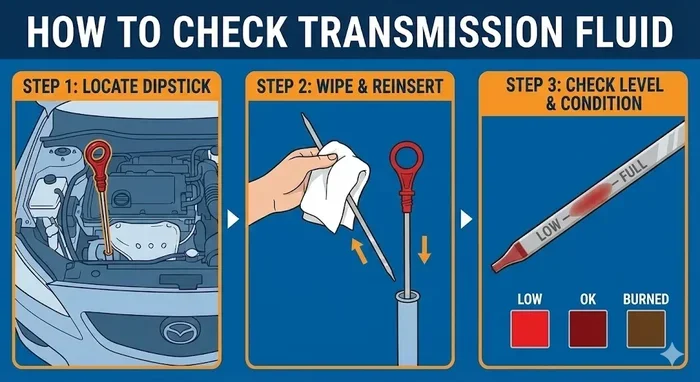
Open your hood and look for the transmission dipstick. It is usually located near the back of the engine bay. For front-wheel-drive vehicles, it is often on the left or right side. The handle is typically colored, often yellow or red, to make it easy to spot.
If you cannot find it, consult your owner manual. Some newer vehicles do not have a traditional dipstick. These cars may have a sealed transmission that requires a professional to check the fluid level.
Step 4: Pull the Dipstick and Wipe It Clean
Carefully pull out the dipstick. Use the rag to wipe it completely clean. This removes any old fluid residue so you can get an accurate reading. Hold the dipstick flat as you wipe it.
Step 5: Reinsert and Pull Again
Slide the dipstick all the way back in. Then pull it out again. Look at both sides of the dipstick. You will see markings that show the minimum and maximum fluid levels. The fluid should fall between these two marks.
If the level is low, you need to add more fluid. Use a funnel and pour slowly. Add a little at a time and recheck the level. Overfilling can be just as bad as underfilling.
Step 6: Check the Fluid Color and Smell
This is just as important as checking the level. Healthy transmission fluid should be a bright red or translucent pink color. It should feel smooth and not have a strong smell.
If the fluid looks dark brown or black, it is old and needs to be changed. If it smells burnt or has particles in it, that is a serious red flag. These are signs of transmission fluid burn and potential internal damage.
Common Mistakes People Make When Checking Transmission Fluid
Even simple tasks can go wrong if you are not careful. Here are some mistakes to avoid:
- Checking the fluid on a cold engine. This gives an inaccurate reading. Always warm up the engine first.
- Not parking on level ground. A sloped surface can make the fluid level look wrong.
- Overfilling the transmission. Too much fluid can cause foaming and pressure problems.
- Using the wrong fluid type. Always match the fluid to what your vehicle requires.
- Ignoring the owner manual. Every car is different. The manual has the exact procedure for your vehicle.
Avoiding these simple mistakes ensures your transmission fluid check gives you reliable results every time.
What Your Transmission Fluid Tells You
The appearance and smell of your fluid can reveal a lot about the health of your transmission. Think of it as a quick health report for your car. Here is what to look for.
Fluid Color Guide
Bright red or translucent pink fluid is healthy and in good condition. This means your fluid is fresh and doing its job properly. Dark brown fluid is aging and may need to be changed soon. Black or very dark fluid is old and degraded. This is a sign that a transmission fluid change is overdue.
If you see milky or foamy fluid, that could mean coolant has leaked into the transmission. This is a serious problem that needs immediate attention from a mechanic. Do not drive the car in this condition.
Smell Test
Healthy fluid has a slightly sweet or neutral smell. If you detect a burnt smell, that is a major warning sign. Burnt fluid means the transmission is overheating. Continued driving in this condition can lead to permanent damage.
Texture Check
Good fluid feels smooth and slick between your fingers. If it feels gritty or rough, there may be metal particles or debris inside the transmission. This usually indicates wear on internal components. A transmission flush might be needed, along with a professional inspection.
Expert Insight
Many experienced mechanics recommend checking your fluid every 30 days. It takes less than five minutes and can catch problems months before they become expensive repairs. A simple transmission fluid check is one of the most underrated maintenance habits you can build.
Manual vs Automatic Transmission: Key Differences
Not all transmissions are the same, and neither is the way you check their fluid. The process differs between manual and automatic vehicles. Understanding these differences helps you check your fluid correctly and safely.
Checking Fluid in an Automatic Transmission
Most automatic transmissions have a dipstick that you can access from the engine bay. The process is straightforward. Warm up the engine, locate the dipstick, wipe it, reinsert it, and pull it out to read the level. The fluid should be between the two marks on the dipstick.
Automatic transmission fluid is designed to handle the high heat and pressure inside the system. It is typically red or pink and has a slippery texture. Check the fluid condition regularly because automatic transmissions are more sensitive to fluid quality.
Checking Fluid in a Manual Transmission
Manual transmissions work differently. Many do not have a dipstick at all. Instead, they have a fill plug on the side or top of the transmission housing. To check the fluid level on a manual transmission, you typically need to jack up the car and remove the plug.
This is a bit more involved than an automatic check. If you are not comfortable doing this yourself, it is perfectly fine to have a mechanic handle it. The good news is that manual transmission fluid generally lasts longer and requires less frequent checks.
| Feature | Automatic Transmission | Manual Transmission |
|---|---|---|
| Dipstick Available | Yes, usually accessible from engine bay | Often no dipstick; uses fill plug |
| Checking Method | Wipe, reinsert, pull out and read | Jack up car, remove fill plug |
| Fluid Color | Red or pink | Gold, amber, or brown |
| Fluid Change Interval | Every 30,000 to 60,000 miles | Every 30,000 to 60,000 miles |
| DIY Difficulty | Easy | Moderate |
| Engine Position During Check | Warm, running or off (check manual) | Warm, engine off |
Knowing which type of transmission you have is the first step. If you are unsure, check your owner manual or look up your vehicle online. The manual will clearly state whether you have an automatic or manual transmission and how to check the fluid.
When to Call a Mechanic Instead of DIY
Checking your fluid at home is great for regular maintenance. But there are times when you should leave it to the professionals. Knowing the difference between a simple check and a serious problem can save you a lot of headaches.
Warning Signs That Need Professional Attention
Watch for these signs that something is seriously wrong with your transmission:
- Transmission slipping between gears while driving
- Delayed or rough shifting when accelerating or decelerating
- Strange grinding or whining noises coming from the transmission area
- Fluid leaking from under the car
- Dashboard warning lights, especially the check engine light or transmission warning light
- Burning smell coming from under the hood
- Fluid that looks milky or has a bubbly texture
If you notice any of these transmission warning signs, do not try to fix them yourself. These symptoms often indicate internal damage that requires specialized tools and expertise. A mechanic can perform a thorough transmission fluid check and diagnose the root cause.
Understanding Transmission Repair Costs
One reason people avoid the mechanic is cost. And that is understandable. But ignoring problems always makes them worse. A simple fluid change might cost between $100 and $250. A transmission flush could run $200 to $400. But if you let a problem go too long, a full transmission rebuild or replacement can cost anywhere from $1,500 to $3,500 or more.
Regular transmission maintenance is your best defense against these high costs. A simple monthly fluid check can catch small issues before they grow into big expenses.
How Often Should You Check Transmission Fluid?
Now that you know how to check your fluid, you might wonder how often you should do it. The answer depends on your driving habits and vehicle type.
As a general rule, check your transmission fluid level once a month. This gives you a consistent baseline and helps you spot changes quickly. If you drive in tough conditions, check more often. Tough conditions include heavy traffic, towing, extreme heat, or dusty roads.
Most manufacturers recommend changing transmission fluid every 30,000 to 60,000 miles. However, some newer vehicles claim to have lifetime transmission fluid. Even with lifetime fluid, it is a good idea to have it checked periodically. Fluid breaks down over time, regardless of mileage.
Transmission Fluid Lifespan Factors
Several factors affect how long your fluid lasts:
- Driving conditions. Stop-and-go city driving is harder on fluid than highway driving.
- Towing or hauling. Extra weight puts more stress on the transmission.
- Climate. Hot weather breaks down fluid faster.
- Vehicle age. Older vehicles may need more frequent fluid changes.
- Driving style. Aggressive acceleration and hard braking wear out fluid faster.
Keeping track of these factors helps you decide when to change your fluid. When in doubt, check your owner manual. It has the recommended maintenance schedule for your specific vehicle.
Quick Tips for Extending Transmission Fluid Life
- Avoid riding the brakes, especially on downhill slopes.
- Shift to park only after the car is fully stopped.
- Do not race the engine when starting the car in cold weather.
- Get a transmission flush every 30,000 to 50,000 miles.
- Use only the fluid type recommended by the manufacturer.
Final Thoughts
So, can I check transmission fluid myself? Absolutely. With the right tools and a little confidence, you can handle this task on your own. It is one of the simplest and most rewarding DIY car maintenance jobs you can do. Regular fluid checks help you stay ahead of problems and keep your transmission healthy for the long haul.
Remember, your transmission is the heart of your vehicle’s drivetrain. Taking care of it with simple transmission fluid maintenance goes a long way. Check the fluid monthly, watch for warning signs, and never ignore strange symptoms. A few minutes of attention now can save you thousands of dollars later.
Start today. Pop your hood, find that dipstick, and give your transmission fluid a quick check. You will be glad you did. And if anything looks off, you now know exactly when to call a mechanic. Your car will thank you for it.
Frequently Asked Questions
How do I know if my transmission fluid is low?
Look for several common signs. Your transmission may slip between gears, hesitate when shifting, or make unusual noises. You can also check the dipstick directly. If the fluid level is below the minimum mark, it is low. Low fluid often causes overheating and poor performance, so address it quickly.
Can I check transmission fluid with the engine off?
It depends on your vehicle type. For most automatic transmissions, you should check the fluid with the engine warm and running. For manual transmissions, the engine should be off. Always check your owner manual to confirm the correct procedure for your specific car model.
What color should healthy transmission fluid be?
Healthy fluid is typically bright red or translucent pink. It should look clean and smooth. If the fluid turns dark brown or black, it is old and needs replacing. Milky or bubbly fluid indicates a more serious problem, like coolant contamination, that needs immediate professional attention.
How much does it cost to have a mechanic check transmission fluid?
A professional fluid check usually costs between $50 and $100 at most shops. However, checking it yourself costs nothing but a few minutes of your time. Since the process is simple and safe for most vehicles, DIY is the more affordable and convenient option for routine maintenance.
Is it safe to add transmission fluid myself?
Yes, adding fluid is safe and straightforward. Use the correct type of fluid recommended in your owner manual. Pour slowly through a funnel into the dipstick tube. Check the level frequently and avoid overfilling. If you are unsure about the fluid type or amount, consult a mechanic before adding anything.
How often should I change my transmission fluid?
Most vehicles need a fluid change every 30,000 to 60,000 miles. However, this varies based on your driving conditions and vehicle model. Check your owner manual for the manufacturer’s recommended schedule. If you tow frequently or drive in extreme heat, you may need to change it more often.