Crank No Start Diagnosis: Your Complete Step-by-Step Guide
A crank no start condition means your engine turns over but refuses to fire up. This guide walks you through a clear, systematic crank no start diagnosis process that anyone can follow. You will learn to check the battery, test fuel delivery, inspect the ignition system, and rule out compression issues. By the end, you will know exactly what to test and in what order. Save time, money, and frustration with these proven steps.
There is nothing more frustrating than turning your key and hearing the engine crank endlessly without firing up. You turn the ignition, the starter motor spins, the engine rotates, but nothing happens. No roar. No life. Just that awful clicking or whirring sound that tells you something is wrong.
This is what mechanics call a crank no start condition. And if you have ever experienced it, you know how stressful it can be. The good news is that a crank no start diagnosis does not have to be scary or complicated. With a clear plan and the right tools, you can figure out exactly what is going on.
In this guide, we will walk you through every step of diagnosing a crank no start problem. Whether you are a beginner DIYer or a seasoned home mechanic, you will find practical advice here. We will cover the battery, the starter, fuel delivery, the ignition system, sensors, and compression testing. By the end, you will have a clear roadmap to get your engine running again.
So grab your tools and let us get started. No guesswork. No throwing parts at the wall. Just a logical, step-by-step approach to solving your engine cranks but won’t start problem.
Key Takeaways
- Start with the basics: Always test battery voltage and connections first before moving to complex checks.
- Follow a systematic approach: Check for spark, fuel, and compression in that order to narrow down the cause quickly.
- Use the right tools: A multimeter, fuel pressure gauge, and spark tester make diagnosis much faster and more accurate.
- Don’t ignore sensors: The crankshaft position sensor and camshaft sensor are common culprits in crank no start conditions.
- Check for error codes: Even if the check engine light is off, stored diagnostic trouble codes can point you in the right direction.
- Safety matters: Work in a well-ventilated area and disconnect the battery before handling electrical components.
📑 Table of Contents
What Is a Crank No Start Condition?
Before we dive into the steps, let us make sure we understand what we are dealing with. A crank no start diagnosis applies when your engine cranks normally but does not start. This is different from a no crank no start situation, where the engine does not turn over at all.
When an engine starts, three things must happen at the same time. You need fuel, spark, and compression. If any one of these is missing, the engine will crank but not fire. Your job during crank no start diagnosis is to figure out which one is missing.
The Fire Triangle of Engine Starting
Think of it like a triangle. Each side represents one essential element:
- Fuel: The engine needs the right amount of fuel at the right pressure.
- Spark: The ignition system must create a strong spark at the right time.
- Compression: The cylinders must seal properly to build enough pressure for combustion.
When you have all three working together, the engine starts. When one is missing, you get a crank no start condition. The goal of our diagnosis is to test each element one by one until we find the problem.
Common Symptoms to Watch For
Sometimes the symptoms give you clues before you even start testing. Here are common signs of a crank no start problem:
- The engine cranks normally but just will not catch.
- You smell fuel near the exhaust after cranking.
- The check engine light was on before the problem started.
- The engine started acting rough in the days before it quit.
- You hear a single click but no cranking at all (this may point to a different issue).
These clues help you narrow down the possibilities. But remember, the only way to be sure is to test. So let us move on to the tools you will need.
Tools You Need for Crank No Start Diagnosis
You do not need a expensive shop full of equipment to diagnose a crank no start condition. A few basic tools will take you a long way. Here is what I recommend having on hand before you begin.
Essential Diagnostic Equipment
- Digital multimeter: This is your best friend for testing battery voltage, sensor signals, and circuit continuity.
- Fuel pressure gauge: This lets you check whether the fuel pump is delivering proper pressure.
- Spark tester: A simple tool that confirms whether you have a strong spark at the spark plug.
- OBD2 scanner: Even if the check engine light is off, this tool can pull stored diagnostic trouble codes that point you toward the problem.
- Basic hand tools: Wrenches, screwdrivers, pliers, and a ratchet set for accessing components.
- Safety glasses and gloves: Protect yourself from fuel, sparks, and moving parts.
Safety First
Before you do anything, make sure you are working in a well-ventilated area. Never smoke near a vehicle that might have a fuel leak. Keep your hands away from the fan and belts when the engine is running. And always disconnect the negative battery terminal before working on any electrical components. Safety should always come first during any crank no start diagnosis.
Step 1 — Check the Battery and Electrical System
Before you chase fancy problems, always start with the simplest explanation. A weak battery or a bad connection is the most common cause of crank no start issues. It is also the easiest to fix.
Test Battery Voltage
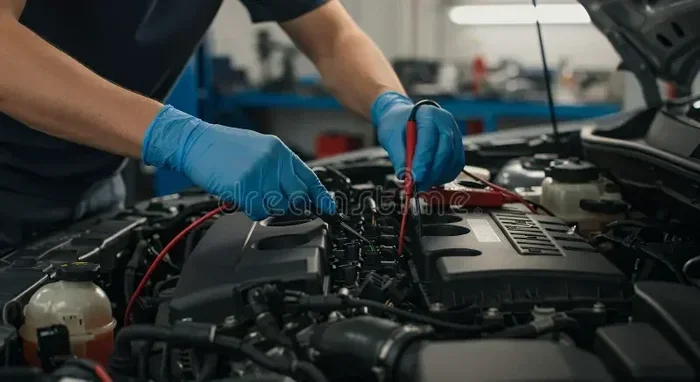
Set your digital multimeter to DC voltage. Touch the red probe to the positive battery terminal and the black probe to the negative terminal. You should see at least 12.6 volts with the engine off.
Now ask someone to turn the key to the crank position while you watch the meter. The voltage should not drop below 10 volts during cranking. If it drops below 9.5 volts, your battery may not have enough power to properly energize the starter motor and the fuel pump. A low battery voltage can cause all kinds of strange starting problems.
If the battery tests low, try charging it fully and testing again. If it still reads weak after a full charge, the battery may be failing and need replacement.
Inspect Battery Connections
Do not overlook the obvious. Corroded or loose battery terminals can cause a crank no start condition even with a good battery. Look at both the positive and negative terminals. If you see white or greenish buildup, clean it off with a wire brush or battery terminal cleaner.
Make sure the cables are tight. Wiggle them gently. If there is any movement, tighten the clamp. A loose connection can cause intermittent starting system problems that are hard to track down.
Check the Starter Motor Circuit
When you turn the key, do you hear the starter motor engage? If you hear nothing, the problem might be in the starter motor circuit itself. Check the starter relay and the ignition switch. You can test the relay by swapping it with a similar relay in the fuse box. If the engine starts after the swap, you have found your problem.
If the starter motor spins but the engine does not turn over, the starter motor gears may be worn or damaged. This is less common but does happen, especially on older vehicles.
Quick Tip: If your engine cranks slowly or weakly, do not assume it is just the battery. A failing starter motor can also cause slow cranking. Test both before replacing parts.
Step 2 — Test Fuel Delivery and Pressure
Once you have confirmed the battery and electrical system are working properly, the next step in your crank no start diagnosis is to check fuel delivery. Without fuel, the engine simply cannot run. Period.
Listen for the Fuel Pump
Turn the ignition key to the ON position (do not start). You should hear a brief humming sound coming from the back of the vehicle. This is the fuel pump priming the system. If you hear nothing, the fuel pump may have failed or the fuel relay could be bad.
A fuel pump failure is one of the most common reasons for a crank no start condition. The pump may work intermittently before it dies completely. If you have been noticing longer cranking times before the engine would start, this could be your answer.
Test Fuel Pressure
Connect your fuel pressure gauge to the fuel rail test port. Have someone crank the engine while you watch the gauge. Compare your reading to the manufacturer specification for your vehicle.
Most vehicles require between 40 and 65 PSI, but check your service manual for the exact number. If the pressure is too low, the problem could be a weak fuel pump, a clogged fuel filter, or a faulty fuel pressure regulator.
If the pressure is zero, check the fuel pump fuse and relay first. Sometimes the fix is as simple as a blown fuse. If the fuse and relay are good, the pump itself likely needs replacement.
Inspect the Fuel Injectors
Even if you have fuel pressure, the fuel injector must deliver fuel properly. You can listen to the injectors with a stethoscope or even a long screwdriver held against the injector body. You should hear a clicking sound when the engine cranks.
No clicking? The injector may be clogged or the powertrain control module may not be sending the correct signal. A clogged fuel injector can prevent the engine from starting even when fuel pressure looks normal.
Quick Tip: Add a small amount of clean fuel to the throttle body if you suspect the fuel pump has drained. This can help you determine if the engine is getting enough fuel to start temporarily while you troubleshoot further.
Step 3 — Inspect the Ignition System and Sensors
If you have confirmed fuel delivery, the next piece of the puzzle is spark. The ignition system is responsible for creating the spark that ignites the fuel-air mixture in the cylinders.
Test for Spark
Remove a spark plug and reattach it to the spark plug wire. Ground the metal part of the plug against the engine block. Have someone crank the engine while you watch for a spark. You should see a bright blue spark. A weak orange or red spark is not enough to ignite the fuel.
No spark at all? The problem could be the ignition coil, the crankshaft position sensor, or the camshaft position sensor. These sensors tell the powertrain control module when to fire the coil. If one of them fails, the engine will crank but produce no spark.
Check the Crankshaft Position Sensor
The crankshaft position sensor is one of the most common causes of a crank no start condition. This sensor tells the engine computer the exact position and speed of the crankshaft. Without this information, the powertrain control module cannot time the spark or fuel delivery correctly.
Use your OBD2 scanner to check for diagnostic trouble codes. A code starting with P0335 or P0336 often points to a crankshaft position sensor problem. You can also test the sensor’s resistance with your multimeter and compare it to the factory specification.
Inspect the Ignition Coil and Spark Plugs
Over time, ignition coils and spark plugs wear out. A fouled or worn spark plug may produce a weak spark that is not enough to start the engine. Remove all spark plugs and inspect them for carbon buildup, fouling, or wear.
If the plugs look bad, replace them. It is a cheap fix that often solves the problem. The same goes for the ignition coil. If you have multiple coils and one is failing, it can cause a no-start condition on the corresponding cylinder.
Check for Anti-Theft or Immobilizer Issues
Do not overlook the immobilizer or anti-theft system. Many modern vehicles have a transponder chip in the key that must be recognized by the powertrain control module before the engine will start. If the system does not recognize the key, it will allow the engine to crank but will not enable fuel or spark.
If your dashboard security light is flashing when you turn the key, the immobilizer is likely the culprit. Try using a spare key. If the spare key works, the original key’s transponder may have failed.
Step 4 — Compression Testing and Advanced Diagnostics
If you have confirmed fuel, spark, and a healthy battery, the next step is to check compression. This is the most involved part of a crank no start diagnosis, but it is essential for ruling out serious engine problems.
Perform a Compression Test
Remove all spark plugs and thread the compression tester into one cylinder. Have someone crank the engine while you watch the gauge. Each cylinder should read within the manufacturer specification, and the readings should be fairly consistent across all cylinders.
If one cylinder reads significantly lower than the others, you may have a valve problem, a head gasket leak, or piston ring damage. If all cylinders read very low, the timing belt or chain may have broken, causing the engine timing to be off.
Check Engine Timing
The engine timing must be correct for the engine to start. If the timing belt or chain has jumped or broken, the valves and pistons will be out of sync. This is a serious problem that requires immediate attention.
To check timing, you may need a timing light and access to the timing marks on the crankshaft and camshaft pulleys. Consult your vehicle service manual for the correct procedure and specifications.
When to Seek Professional Help
Sometimes a crank no start diagnosis reveals a problem that is beyond DIY repair. Internal engine damage, a broken timing chain, or a failed powertrain control module may require professional tools and expertise. Do not hesitate to call a qualified mechanic if you have exhausted all the basic checks. There is no shame in getting expert help, especially when the repair involves major engine components.
Key Takeaways
- Always start simple: Battery and connections first. They are the most common and easiest to fix.
- Test systematically: Check fuel, then spark, then compression. Do not skip steps.
- Use the right tools: A multimeter, fuel pressure gauge, and spark tester will save you hours of guesswork.
- Read the codes: Even stored diagnostic trouble codes can point you toward the root cause.
- Do not ignore the immobilizer: A faulty anti-theft system can prevent starting even when everything else looks fine.
- Know your limits: If compression or internal engine damage is suspected, seek professional help.
Conclusion
A crank no start diagnosis does not have to be overwhelming. By following a logical, step-by-step process, you can narrow down the cause and find the solution. Start with the battery and electrical system, then move to fuel delivery, ignition, and finally compression and timing.
Most crank no start problems come down to a few common causes: a dead battery, a failed fuel pump, a bad crankshaft position sensor, or a worn ignition component. By testing each element of the starting process, you can identify exactly what is wrong and fix it.
Remember, patience is your best tool. Do not rush to replace parts without testing first. Take your time, follow the steps in this guide, and you will solve the problem. And if you get stuck, there is no shame in asking a professional for help. The goal is to get your engine running safely and reliably again.
Now you have a complete roadmap for crank no start diagnosis. Put these steps into action, and you will be back on the road in no time.
Frequently Asked Questions
What is the most common cause of a crank no start condition?
The most common cause is a failure in the fuel system, particularly a fuel pump failure or a clogged fuel filter. A weak battery or a faulty crankshaft position sensor are also very common culprits. Starting with the simplest checks helps you find the answer faster.
How do I know if my engine has spark during a crank no start diagnosis?
Remove a spark plug, reattach the spark plug wire, and ground the plug against the engine block. Have someone crank the engine and look for a bright blue spark. If you see no spark or a weak orange spark, the ignition system needs further testing.
Can a bad crankshaft position sensor cause a crank no start problem?
Yes, absolutely. The crankshaft position sensor tells the engine computer when to fire the spark plugs and injectors. If it fails, the engine will crank but not start because the powertrain control module cannot time the ignition or fuel delivery correctly.
What should I do if my fuel pump does not hum when I turn the key to ON?
First, check the fuel pump fuse and relay. If those are good, the pump may be dead. Use a fuel pressure gauge to confirm whether fuel is being delivered. If pressure is zero, the pump likely needs replacement or the wiring to the pump needs to be inspected.
Is it safe to keep cranking the engine during diagnosis?
Limit cranking sessions to about 10 seconds at a time. Allow at least 30 seconds between attempts to let the starter motor cool down. Excessive cranking can overheat the starter and drain the battery further, making your crank no start diagnosis harder.
When should I take my car to a professional for crank no start diagnosis?
If you have checked the battery, fuel delivery, spark, and compression and still cannot find the problem, it is time to see a professional. Issues involving internal engine damage, broken timing chains, or powertrain control module failures require specialized tools and expertise that go beyond basic DIY repairs.